INTERNATIONAL RESEARCH & EXCHANGES BOARD
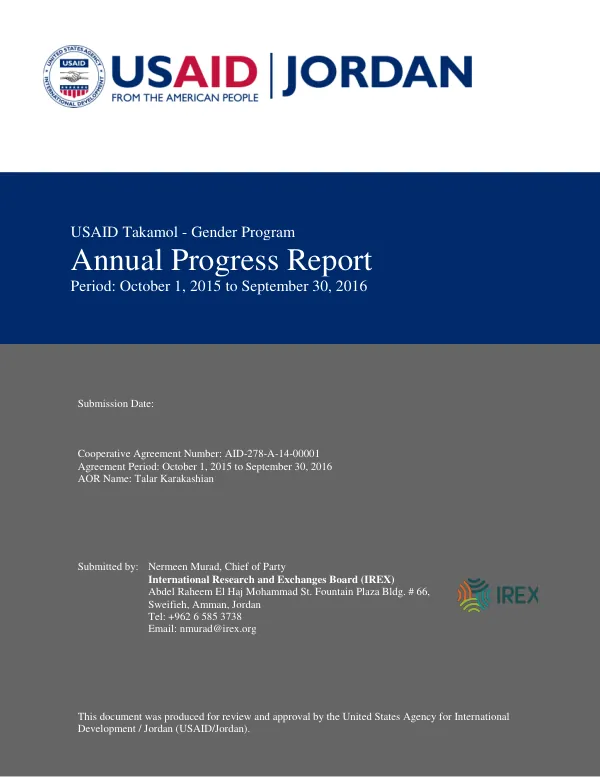
Year 2 Annual Report: USAID Takamol-Gender Program
The agricultural development initiative in the USAID Takamol-Gender Program began in 2014 and aimed to improve gender equity in Jordan.
2016 · 41 pages
Sign in to readA free account is required to download.
Abstract
The program focused on designing and continuing initiatives and activities that addressed program indicators by engaging national and local stakeholders. To achieve its objectives, the program implemented various initiatives, including social dialogue, advocacy and outreach, capacity building, civil society, and campaigning efforts. IREX, the prime implementing partner, worked with various stakeholders, including the Government of Jordan, to assess gender needs and provide opportunities for growth and development. The program collaborated with the Government of Jordan to strengthen Gender Audit Teams (GATs) across seven ministries, including the newly formed teams in the Ministry of Labour and the Ministry of Labour's newly formed teams. Takamol also worked with the Jordanian National Commission for Women (JNCW) to train 50 Gender Focal Points (GFPs) in 21 governmental institutions. The program held a training for 180 female employees of the Ministry of Public Sector Development (MoPSD) on "Empowering Women in the Civil Service." Takamol also assisted MoPSD in reviewing legislative policy that negatively impacted women. Additionally, the program worked with various other ministries, such as the Ministry of Education and the Ministry of Labour, to promote gender equality and social dialogue. Takamol launched subgrants to the Haya Cultural Center (HCC) and the Arab Network for Civic Education (ANRE), both of which implemented innovative approaches to promoting gender equality and social dialogue. The HCC's "Beyond Boy and Girl" campaign aimed to expand youth dialogue on gender stereotypes and emphasize the importance of gender equality in Jordanian society. The program's social dialogue component had notable successes, including the El Ma7ki Ma3 Takamol initiative, which used poetry as a medium to promote conversations on gender-related issues. The initiative received widespread attention in newspapers and national media outlets. Takamol also implemented the APT initiative, which encouraged local artists to create murals in high-traffic areas that sparked conversations on gender-related issues. Takamol's most successful initiative during this reporting period was the start-up of Souk Takamol, which provided technical and financial support to community-based organizations working on gender initiatives. Round One of Souk Takamol oversaw the application of 130 community-based organizations, with 13 receiving funding based on a pool of cast votes. The program's public policy component aimed to promote gender equality and social dialogue. Takamol worked with the Government of Jordan to assess gender needs and provide opportunities for growth and development. The program also collaborated with the Jordanian National Commission for Women (JNCW) to train 50 Gender Focal Points (GFPs) in 21 governmental institutions. Takamol's efforts in capacity building with the Ministry of Public Sector Development (MoPSD) aimed to better understand and implement gender mainstreaming. The program held a training for 180 female employees of MoPSD on "Empowering Women in the Civil Service." Takamol also assisted MoPSD in reviewing legislative policy that negatively impacted women. The program's civil society component aimed to promote gender equality and social dialogue. Takamol launched subgrants to the Haya Cultural Center (HCC) and the Arab Network for Civic Education (ANRE), both of which implemented innovative approaches to promoting gender equality and social dialogue. Overall, the USAID Takamol-Gender Program aimed to improve gender equity in Jordan by promoting social dialogue, advocacy and outreach, capacity building, civil society, and campaigning efforts. The program implemented various initiatives, including the El Ma7ki Ma3 Takamol initiative, the APT initiative, and the Souk Takamol initiative, which received widespread attention in newspapers and national media outlets.
Related documents