ECO CONSULTING GROUP
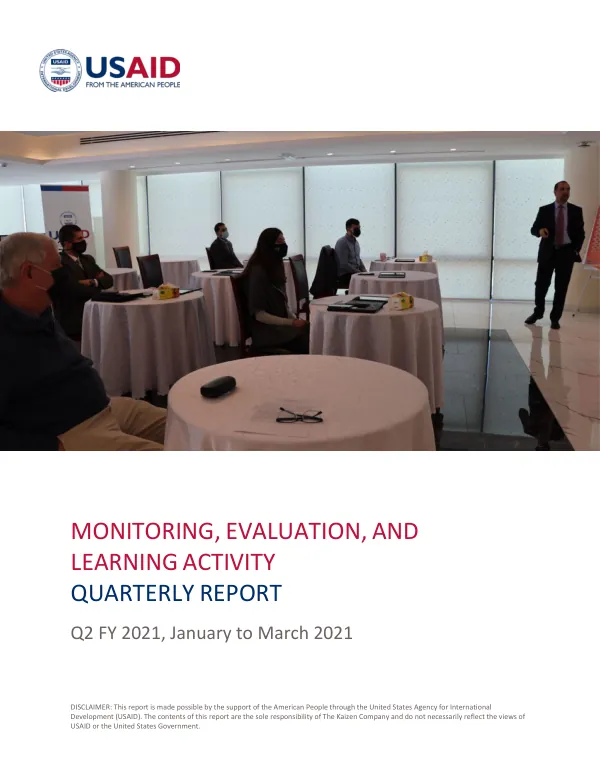
Monitoring, Evaluation, and Learning Activity - Quarterly Report Q2 FY 2021
The Monitoring, Evaluation, and Learning Activity in Jordan began in February 2020, with The Kaizen Company serving as the prime implementing partner.
2021 · 92 pages
Sign in to readA free account is required to download.
Abstract
The activity aims to increase the utilization of evaluation and assessment findings for operational decision-making and future programming. A key focus of the work is to identify and address how USAID/Jordan anticipates utilizing the findings from the activity to inform future programming and operational decision-making. The activity's interventions have contributed to USAID/Jordan's increased utilization of evaluation and assessment results for operational decision-making and future programming. A key example of this is the ongoing work on a School Infrastructure Multi-Activity Evaluation and an Assessment of Water consumption patterns in the agriculture sector. These evaluations will inform USAID future interventions in the education and agriculture sectors. During the reporting period, the team led two assessments, two evaluations, and two data verification requests. The Street Naming and Building Numbering (SNBN) and Local Economic Development (LED) assessment was successfully completed, and each final report was approved by USAID/Jordan. The Market Systems Development assessment began the data collection phase after completing the Inception Report. The School Infrastructure Multi-Activity Evaluation commenced with the onboarding of four consultants and kick-off with USAID on March 17, 2021. The activity also provided substantial support in the areas of data visualization and work on improving existing USAID data systems. The activity responded rapidly and effectively to a request to provide data visualization for a USAID presentation intended for senior Embassy officials. Substantial work continued on the review of the Mission Performance Management Plan (PMP). The activity rolled out the Collaboration, Learning and Adapting (CLA) maturity survey among Implementing Partners (IPs) and the Mission. Pause and reflect sessions were conducted on the overall conduct of evaluation and surveys, leading to the development of a learning agenda to improve the way such evaluations and assessments are undertaken. The activity has sought to make learning and adaptation more central to the activity's work. In terms of strategic communications, the activity continues to maintain a robust presence on the LinkedIn network. The activity contributed six news posts to USAID over the reporting period. The activity continued its efforts to improve the capacity of local partners, conducting an organizational capacity assessment and awarding its first contract through the Accelerator Program. A key challenge faced by the team during this quarter was finding appropriate candidates for the School Infrastructure Multi-Activity Evaluation, which took longer than anticipated. The activity worked closely with its Contracting Officer's Representative (COR) to find qualified candidates for the Evaluation Team and to manage EDY team expectations. The COVID-19 pandemic continues to hamper efforts and led to the postponement of the Monitoring, Evaluation, and Learning (MEL) Conference originally planned for Fall, 2021. The activity's work is guided by USAID's focus on rigorous Monitoring, Evaluation, and Learning of interventions as part of their practices to improve performance management, accountability, and evidence. The activity team works with the Accelerator, a Rapid Procurement Mechanism, and a group of Local Monitoring, Evaluation and Learning Organizations (LMOs) to successfully deliver projects while strengthening their management and compliance systems. The activity's purpose is to provide a detailed account of the activity's Q2 Fiscal Year (FY) 2021 progress to date, including key achievements, issues, learning, and resolution, and planned activities for the upcoming quarter. The activity's implementation is focused on increasing the utilization of evaluation and assessment findings, with key achievements including the completion of the Street Naming and Building Numbering (SNBN) and Local Economic Development (LED) assessment and the commencement of the School Infrastructure Multi-Activity Evaluation. The activity's planned activities for the upcoming quarter include the completion of the Market Systems Development assessment, the School Infrastructure Multi-Activity Evaluation, and the Assessment of Water consumption patterns in the agriculture sector. The activity will also continue to provide substantial support in the areas of data visualization and work on improving existing USAID data systems.