CENTER FOR EDUCATIONAL DEVELOPMENT
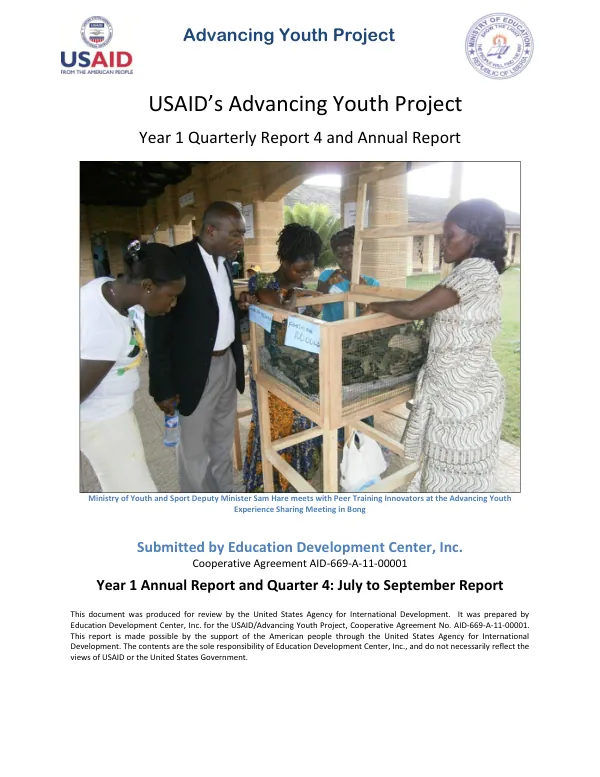
Year 5 Annual and Quarter 4 Report: Advancing Youth Project
The Advancing Youth Project, a USAID-funded initiative, aimed to increase institutional capacity, access to education and skills training, and sustainable livelihoods for targeted youth in Liberia.
2016 · 179 pages
Sign in to readA free account is required to download.
Abstract
The project's Year 5 Annual and Quarter 4 Report highlights key achievements and challenges faced during this period. Institutional capacity was a primary focus, with the Ministry of Education (MoE) developing national policies, preparing annual implementation plans and budgets, and training ABE teachers. Local institutions also demonstrated capacity to partner with the MoE to deliver quality ABE instruction and promote entrance and persistence in ABE. A comprehensive ABE curriculum was developed and implemented, with ABE facilitators receiving training to effectively teach all levels of the curriculum. Access to relevant basic education and life, work, and technical skills training for out-of-school youth was another key area of focus. Strategies for retaining and recruiting youth, especially young women, were planned and implemented. ABE facilitators demonstrated capacity to effectively teach all levels of the ABE curriculum, and national and county public and private alliances were established to provide increased work-based learning, skills training, and entrepreneurship opportunities for targeted youth. Sustainable livelihoods pathways were also a key area of focus, with selected NGOs demonstrating capacity to deliver livelihood training programs based on locally assessed needs. Partnerships were established to provide internship and training opportunities for targeted youth. Monitoring and evaluation activities were also conducted to assess project progress and identify areas for improvement. Despite challenges posed by the Ebola crisis, the project made significant progress in Year 5. However, due to the project's original Life of Project (LOP) ending on October 23, 2016, a cost extension was requested to mitigate the effects of the crisis and implement additional activities. Although this request was not approved, a no-cost extension was received in July 2016, allowing the project to continue until June 15, 2017. With this extension, activities were re-prioritized, focusing on community transition meetings, policy framework development, and implementation of Action Research Activities. The project's Year 5 Annual and Quarter 4 Report highlights the importance of continued support for education and skills training in Liberia, particularly in the context of the Ebola crisis. The report also emphasizes the need for sustained efforts to build institutional capacity, promote access to education and skills training, and support sustainable livelihoods pathways for targeted youth. The Advancing Youth Project's work in Liberia has been supported by a range of stakeholders, including the Ministry of Education, local institutions, NGOs, and community members. The project's success has been demonstrated through the development of national policies, the establishment of alliances for youth education and employment, and the provision of livelihood training programs. However, the project's closure in June 2017 marked the end of a significant period of support for education and skills training in Liberia, highlighting the need for continued investment in this area. The project's legacy continues to be felt in Liberia, with many of the institutions and alliances established during the project's implementation continuing to provide support for education and skills training. The project's work has also informed the development of national policies and guidelines for Alternative Basic Education, providing a foundation for future initiatives in this area.