TETRA TECH
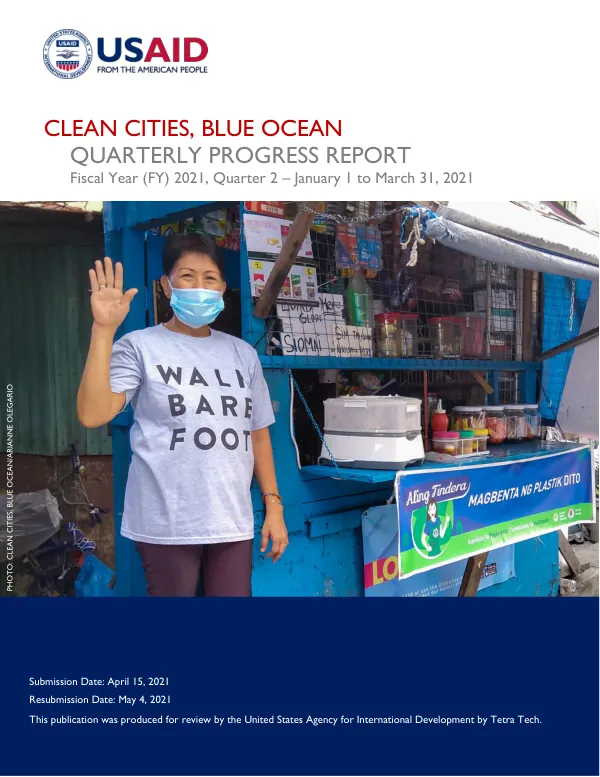
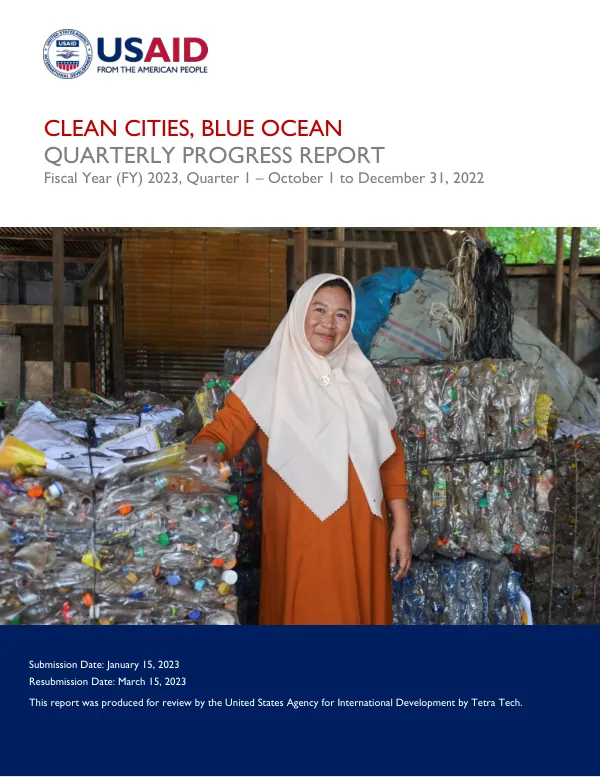
Year Four (FY) 2023 Quarter One Progress Report
Clean Cities, Blue Oceans is a five-year program initiated by the U.S.
2023 · 84 pages
Sign in to readA free account is required to download.
Abstract
Agency for International Development (USAID) to address ocean plastic pollution. The program aims to reduce, reuse, and recycle (3Rs) plastics in urbanizing countries. Tetra Tech was awarded a $48 million contract to implement the program, which will receive an additional $4 million in Year Four, totaling $52 million. The program's main objectives are to promote 3Rs practices, strengthen local and regional markets for recycled plastics, build social and behavior change (SBC) for 3Rs and sustainable solid waste management (SWM), increase capacity and governance of SWM systems, and support international partnerships and alliances. The program focuses on six focus areas, including building capacity for improved solid waste management, improving enabling environments for 3Rs, building SBC for 3Rs and SWM, addressing gender equality and women's empowerment, strengthening public-private partnerships, and combating marine plastics. The program operates in several countries, including Latin America, the Caribbean, Asia, and Asia-Pacific Islands. In the first quarter of Year Four, the program achieved several milestones, including the onboarding of 2,500 farmers for training in sustainable agriculture practices, the establishment of 15 demonstration plots, and the facilitation of market linkage for farmers. The program also reported a 27% increase in household income among program participants compared to the control group. The program's technical assistance helped improve solid waste management in several countries, including Indonesia, where local waste facilities were assisted to improve waste management practices. The program also reported progress in improving enabling environments for 3Rs, building SBC for 3Rs and SWM, and addressing gender equality and women's empowerment. The program's management and operations are overseen by Tetra Tech, with support from several subcontractors and subcontractors. The program's monitoring, evaluation, and learning (MEL) system tracks progress and identified several challenges, including challenges in implementing irrigation techniques and irrigation equipment. The program's financial overview for the first quarter of Year Four shows a total expenditure of $12.5 million, with $8.5 million allocated for program implementation and $4 million for management and operations. The program's deliverables for the first quarter include the completion of 15 demonstration plots, the facilitation of market linkage for farmers, and the onboarding of 2,500 farmers for training in sustainable agriculture practices. The program's focus areas include building capacity for improved solid waste management, improving enabling environments for 3Rs, building SBC for 3Rs and SWM, addressing gender equality and women's empowerment, strengthening public-private partnerships, and combating marine plastics. The program operates in several countries, including Latin America, the Caribbean, Asia, and Asia-Pacific Islands. The program's main objectives are to promote 3Rs practices, strengthen local and regional markets for recycled plastics, build SBC for 3Rs and SWM, increase capacity and governance of SWM systems, and support international partnerships and alliances. The program's management and operations are overseen by Tetra Tech, with support from several subcontractors and subcontractors.