BANK FOR WEST AFRICAN DEVELOPMENT
Semi-Annual Report: End Neglected Tropical Diseases in Asia
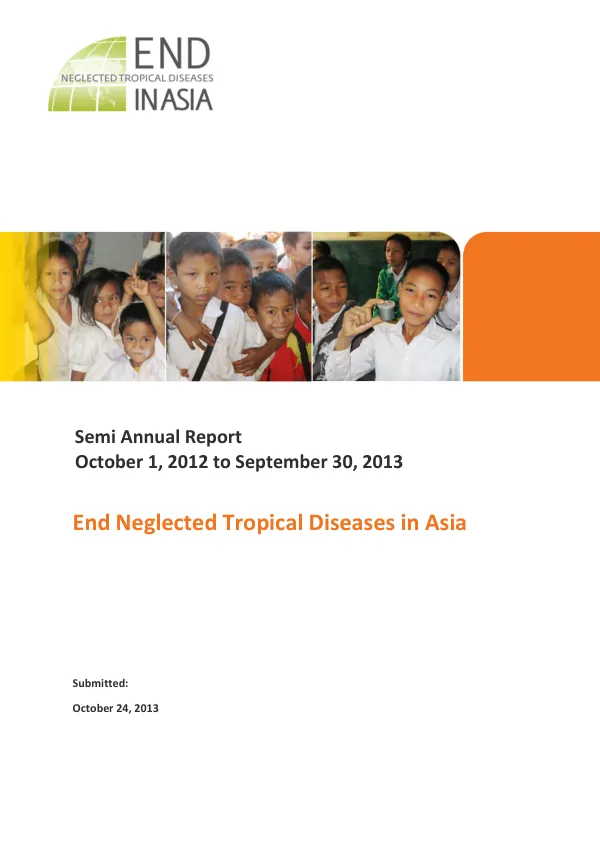
The End Neglected Tropical Diseases in Asia project, managed by Family Health International (FHI 360), aimed to strengthen national programs in five focus countries - Bangladesh, Cambodia, Laos, the Philippines, and Vietnam - to control and eliminate Neglected Tropical Diseases (NTDs).
2013 · 28 pages
Sign in to readA free account is required to download.
Abstract
The project, funded by the United States Agency for International Development (USAID), commenced in October 2011 and continued through September 2013. Implementation in Bangladesh, the Philippines, and Vietnam began on October 1, 2011, based on approved Collaborative Workplans, and proceeded on schedule and within budget throughout the reporting period. In Cambodia and Laos, implementation began in September 2012 and October 2012, respectively, following the approval of their respective Collaborative Workplans. FHI 360 staff provided financial administration and procurement services for specific support activities in Bangladesh and Vietnam, while the National NTD Programs remained responsible for organization and implementation of program activities in Cambodia, Laos, the Philippines, and Papua New Guinea. FHI 360 hired full-time staff in each country to manage program funds, working closely with National NTD Program staff. The project's coverage and treatment results, as well as other relevant data, were officially reported to USAID/ENVISION in March and September 2013 using the standard END in Asia Workbook reporting format. A Scoping Mission to Papua New Guinea (PNG) was organized in October 2012 to assess the possibility of END in Asia assisting the National Department of Health to strengthen their NTD control efforts. Following the enthusiastic response from senior health officials, USAID agreed to move forward with a pilot program for lymphatic filariasis (LF) elimination through Mass Drug Administration (MDA) in one province, New Ireland. The Project Director attended a Partner's Meeting organized by USAID/W in Washington DC in December 2012, which strengthened coordination among END in Asia, END in Africa, and ENVISION. The Project Director also attended the WHO-sponsored GET2020 Meeting in Geneva in April 2013, which focused on reaching consensus on the most appropriate methodology for the proposed National Trachoma Action Plan. The project's management systems and experienced staff were in place to administer project support in each of the six focus countries, with oversight and coordination provided by the Project Director and senior staff at the FHI 360 Asia Pacific Regional Office in Bangkok. Monitoring of implementation in the field, environmental compliance, and financial administration of the subagreements was organized as required in each country, with consistently excellent results. The coverage and treatment results of END in Asia, as well as other relevant data from the National NTD Program in each country, were officially reported to USAID/ENVISION in March and September 2013 using the standard END in Asia Workbook reporting format. The project's progress and achievements were documented in the Semi-Annual Report, which provided a comprehensive overview of the project's activities, outcomes, and lessons learned during the reporting period. The project's focus on strengthening national programs, improving program management, and increasing local community mobilization and participation contributed to the successful implementation of NTD control and elimination activities in the five focus countries. The project's achievements and lessons learned will inform future NTD control and elimination efforts in the region.