USAID DEC
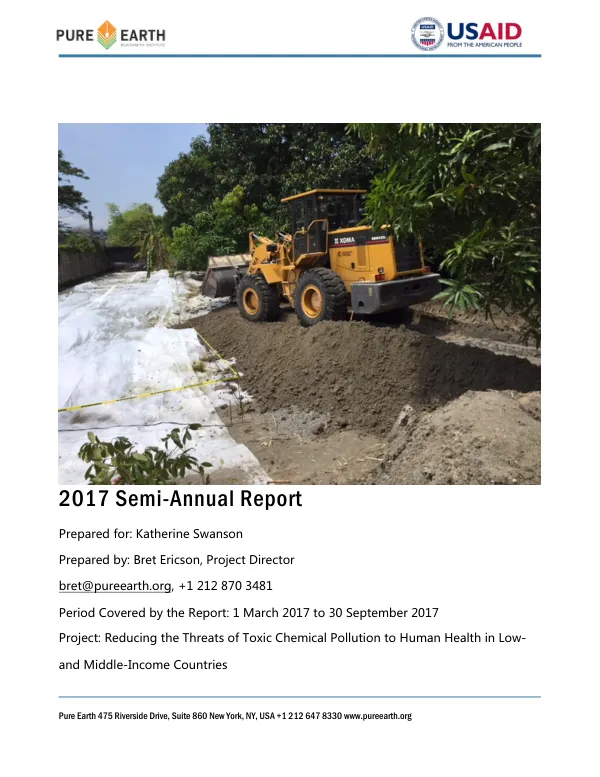
2017 Semi-Annual Report: Reducing the Threats of Toxic Chemical Pollution to Human Health in Low- and Middle-Income Countries
Sign inDONG NAI PROVINCE DEPARTMENT OF NATURAL RESOURCES AND THE ENVIRONMENT
2017 Semi-Annual Report: Reducing the Threats of Toxic Chemical Pollution to Human Health in Low- and Middle-Income Countries
The overall goal of the project is to assist governments and communities heavily impacted by toxic pollution in poor countries to take locally led action to mitigate health exposures by breaking pollution exposure pathways and preventing future toxic emissions.
2017 · 134 pages
Sign in to readA free account is required to download.
Abstract
The project is executed by Pure Earth (PE) in eight countries (Bangladesh, Colombia, India, Jamaica, Mongolia, the Philippines, Senegal, Vietnam) and contains three broad objectives, each with its own set of activities and outputs. Objective One: Toxic Sites Identification Program (TSIP) aims to improve existing knowledge and gather critical data about the scope of toxic pollution and its human health impacts by expanding the TSIP. As of the reporting period, 3 TSIP trainings were conducted, with a total of 95 investigators trained, including 26 women and 69 men. Additionally, 145 government staff were trained, with 74 women and 71 men. Objective Two: Mainstreaming aims to encourage national and international decision-makers to mainstream the issue of toxic pollution, chemicals, and wastes and associated impacts on human health and the environment into development agendas through awareness raising, presentation of scientifically-based evidence, and encouraging action. Progress against this objective is not explicitly stated in the provided information. Objective Three: Pilot Projects aims to assist decision-makers and communities in five countries to mitigate the impacts of toxic pollution, chemicals, and wastes on human health and the environment through training and capacity building, and provision of technical expertise and support, for specific interventions that produce measurable reductions in exposure risk. Progress against this objective is not explicitly stated in the provided information. The project has made significant progress in conducting site screenings, with a total of 205 site visits conducted, and 1543 samples taken. Additionally, 472 stakeholders were interviewed, including 149 women and 323 men. The project has also made progress in training investigators and government staff, with a total of 95 investigators and 145 government staff trained. The project has a strong focus on gender considerations, with a goal of achieving 50% female participation in all activities. As of the reporting period, 26 women investigators and 50 women government staff were trained, representing 27% and 34% of the total number of investigators and government staff trained, respectively. The project has a budget of $X, with $Y allocated for the reporting period. The project has made significant progress in achieving its objectives, with a total of 205 site visits conducted, 1543 samples taken, and 472 stakeholders interviewed. The project has also made progress in training investigators and government staff, with a total of 95 investigators and 145 government staff trained. The project has a strong focus on environmental mitigation and monitoring, with a goal of reducing exposure risk and preventing future toxic emissions. The project has made significant progress in this area, with a total of 205 site visits conducted, and 1543 samples taken. The project has also made progress in training investigators and government staff, with a total of 95 investigators and 145 government staff trained. The project has a strong focus on mainstreaming the issue of toxic pollution, chemicals, and wastes and associated impacts on human health and the environment into development agendas. The project has made significant progress in this area, with a total of 472 stakeholders interviewed, including 149 women and 323 men. The project has also made progress in training investigators and government staff, with a total of 95 investigators and 145 government staff trained. The project has a strong focus on mainstreaming the issue of toxic pollution, chemicals, and wastes and associated impacts on human health and the environment into development agendas. The project has made significant progress in this area, with a total of 472 stakeholders interviewed, including 149