NORC AT THE UNIVERSITY OF CHICAGO
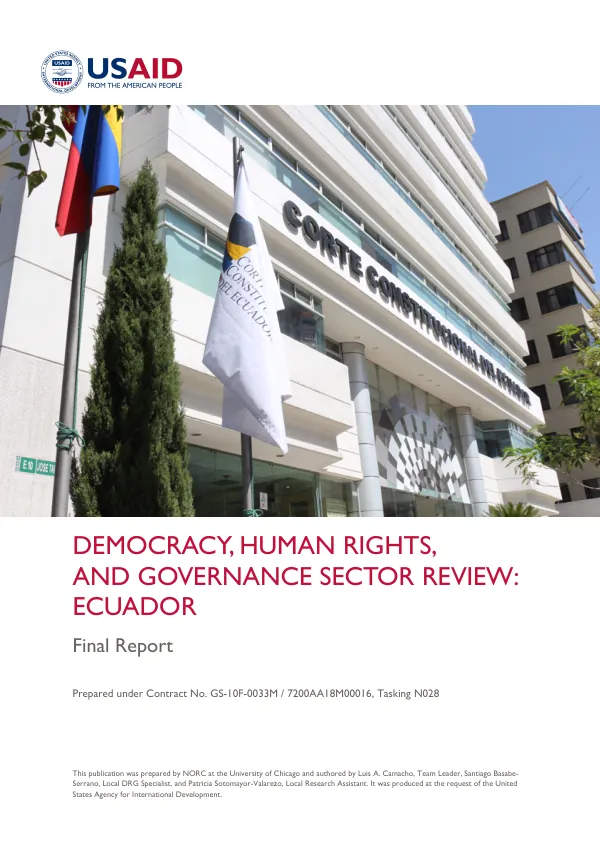
Democracy, Human Rights, and Governance Sector Review: Ecuador
The Democracy, Human Rights, and Governance Sector Review in Ecuador was conducted by NORC at the University of Chicago under the Democracy, Human Rights, and Governance Learning, Evaluation and Research (DRG-LER) II Activity.
2020 · 43 pages
Sign in to readA free account is required to download.
Abstract
The goal of the review was to provide an independent assessment of the current situation and future prospects for strengthening Democracy, Human Rights, and Governance (DRG) in Ecuador. Ecuador is a country with a complex history of political instability, characterized by the constant instability of its political institutions and rulers. The country has designed more than 20 constitutions in its history, and has ratified three constitutions since the last return to democracy in 1979. Coups d'état have been a common part of Ecuador's political history, and three constitutionally-elected presidents were not able to complete their terms due to impeachment or resignation. The review identified several key challenges related to the five elements of the political system: consensus, inclusion, competition and accountability, rule of law and human rights, and government responsiveness and effectiveness. Ecuador continues to struggle with long-standing divisions in its political regime, national identity, and the role of religion in public life. The country has also struggled to find consensus on how to achieve sustained and equitable economic growth. Inclusion is another significant challenge, as most Ecuadorians remain excluded from other forms of political participation, as well as from meaningfully participating in the economy and society. The indigenous population, women, Afro-descendants, and the poor have been systematically excluded, and undoing these ingrained patterns of exclusion will take years of inclusive policies across multiple sectors. The rules for political competition in Ecuador are ever-changing and hinder political party consolidation. Poor electoral rules combined with various structural features and political events have resulted in a fractured party system characterized by a succession of new parties and movements that serve as electoral vehicles for individuals from outside the party system. This has limited the prospects for meaningful electoral accountability. The review also highlighted the importance of the rule of law and human rights in Ecuador. The country has a complex system of justice, with multiple institutions and actors involved in the administration of justice. However, the system is often characterized by inefficiencies, corruption, and lack of transparency, which can undermine the rule of law and human rights. In terms of government responsiveness and effectiveness, the review noted that Ecuador's government has historically been characterized by a development model based on government intervention in the markets. However, this model has been criticized for its inefficiencies and lack of transparency. The government has attempted to enact structural reforms aligned with the Washington Consensus, but these efforts have been met with resistance from various sectors of society. The review made several recommendations for USAID's DRG strategy in Ecuador, including the need to strengthen the rule of law and human rights, promote inclusive policies, and support the development of a more effective and responsive government. The review also emphasized the importance of addressing the country's deep economic and political cleavages, as well as its ethnic cleavages, particularly between the indigenous population and the white-mestizo population. Overall, the review provided a comprehensive assessment of the current situation and future prospects for strengthening DRG in Ecuador. The recommendations made by the review can help inform USAID's DRG strategy in the country and support the development of a more stable and inclusive democracy.
Related documents