THE WORLD FOOD PROGRAMME
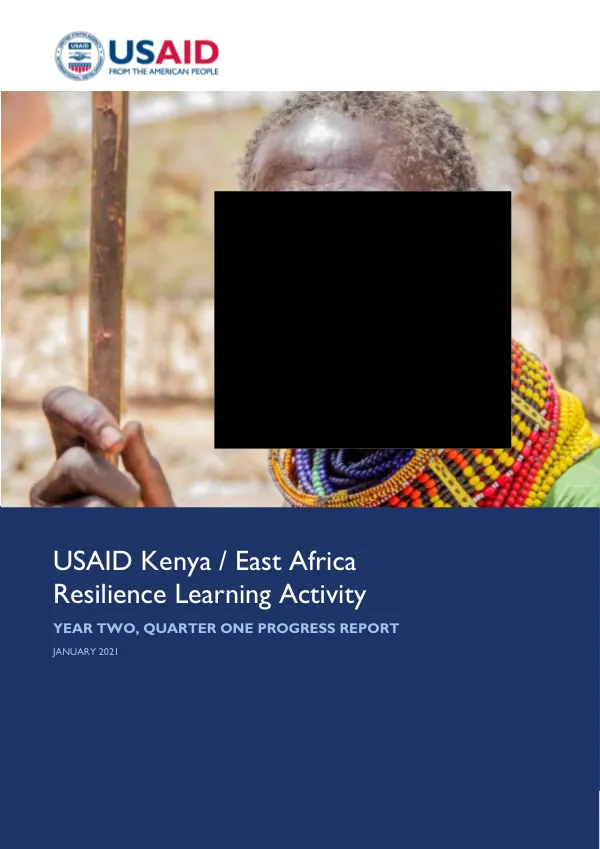
Year Two, Quarter One Progress Report: Resilience Learning Activity
The Resilience Learning Activity (RLA) in Kenya, led by USAID, aims to enhance the resilience of local and host country organizations in the face of recurrent crises.
2021 · 41 pages
Sign in to readA free account is required to download.
Abstract
The initiative focuses on four key components: increasing analytic capacity, facilitating learning for adaptive management, improving knowledge management and strategic communication, and establishing and strengthening systems and networks for Collaborating, Learning, and Adapting (CLA). In Kenya, the RLA has made significant progress in the South Eastern Kenya Coordination Mechanism (SEK), where it has established a facilitation approach to support local organizations in adapting to changing circumstances. The initiative has also harnessed collaboration to demonstrate effectiveness, providing recommendations and evidence to USAID. In addition, the RLA has improved knowledge management and strategic communication, enabling local organizations to share best practices and lessons learned. The RLA has also made progress in Somalia, where it has established a facilitation approach to support local organizations in adapting to changing circumstances. The initiative has harnessed collaboration to demonstrate effectiveness, providing recommendations and evidence to USAID. In addition, the RLA has improved knowledge management and strategic communication, enabling local organizations to share best practices and lessons learned. In East Africa, the RLA has made significant progress in supporting the Horn of Africa Resilience Network (HoRN), which was established by USAID in 2012 to support the use of mutually enforcing activities to build resilience capacities to shocks and to support learning and collaboration across the network. The RLA has also supported the Partnership for Resilience and Economic Growth (PREG), which brings together humanitarian and development partners to build and strengthen resilience among vulnerable pastoralist communities in Northern Kenya. Despite challenges, the RLA has made significant progress in implementing its activities, including the establishment of a GIS system to support data collection and analysis. The initiative has also made progress in promoting gender and social inclusion, with a focus on empowering women and marginalized communities. In addition, the RLA has made progress in environmental mitigation and monitoring, with a focus on reducing the environmental impact of its activities. The RLA has also made progress in linking its activities to other USAID programs, including the Journey to Self-Reliance (J2SR) initiative, which aims to achieve more significant development outcomes and work towards a time when foreign assistance is no longer necessary. The RLA has also made progress in sustainability and exit strategy, with a focus on ensuring that its activities are sustainable and can be replicated by local organizations. Overall, the RLA has made significant progress in implementing its activities and achieving its objectives, despite challenges and constraints. The initiative continues to support local and host country organizations in building their resilience capacities and adapting to changing circumstances.