USAID DEC
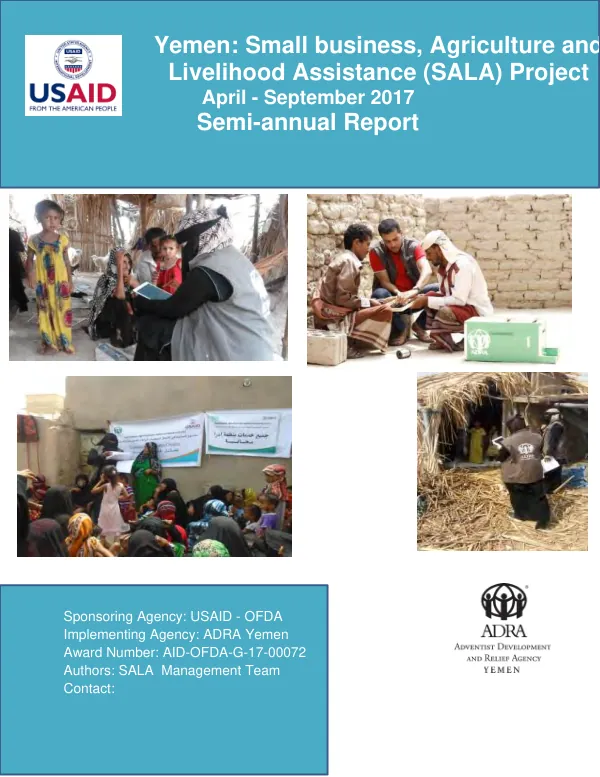
Yemen: Small business, Agriculture and Livelihood Assistance (SALA) Project Semi-annual Report April - September 2017
Sign inUSAID DEC
Yemen: Small business, Agriculture and Livelihood Assistance (SALA) Project Semi-annual Report April - September 2017
The SALA project in Yemen aimed to increase resilience among targeted populations through sustainable livelihood strategies.
2017 · 16 pages
Sign in to readA free account is required to download.
Abstract
The project was implemented by ADRA Yemen, with funding from USAID's OFDA, and focused on agriculture and food security, economic recovery and market systems, water, sanitation, hygiene, and wash-related non-food items, and nutrition. The project's goal was to support vulnerable households in Abyan, Lahj, and Al-Dhale'e governorates. The project's implementation began with coordination meetings with local authorities and the Agriculture Offices in Abyan, Lahj, and Al-Dhale'e to identify and select potential communities and enroll potential beneficiaries' households. ADRA's technical team visited the proposed communities to assess the feasibility of the conditions for beekeeping pastures, animal care, and availability of fodder, and good conditions for agriculture and irrigation activities. In the selected communities, committees were created and trained on the project's goal, selection criteria, participatory management and monitoring methodology, and complaint mechanism. The project's sector-level beneficiaries included 15,750 households targeted for agriculture and food security, 5,250 households targeted for economic recovery and market systems, 55,342 households targeted for water, sanitation, hygiene, and wash-related non-food items, and 192,000 households targeted for nutrition. However, the project's reporting period reached zero beneficiaries in all sectors, as the first months of the project were invested in coordinating with stakeholders, identifying communities, establishing community committees, recruiting staff, and selecting and verifying beneficiaries. In the agriculture and food security sector, ADRA team conducted coordination meetings with local authorities and the Agriculture Offices to identify and select potential communities and enroll potential beneficiaries' households. The team visited the proposed communities to assess the feasibility of the conditions for beekeeping pastures, animal care, and availability of fodder, and good conditions for agriculture and irrigation activities. Ten committees were elected in Abyan, 14 in Lahj, and 3 in Al-Dhale'e. The committees proposed a potential beneficiaries' list of 1,232 households to be enrolled on livestock and agriculture activities. In the livestock sector, 209 households proposed by community committees to receive goats were verified door-to-door by ADRA teams. Out of those, 176 were approved and confirmed as meeting the selection criteria. One hundred and thirty female-headed households received a two-day training on basic care and best practices of animal care. ADRA team designed fences with logos of USAID and ADRA and procured contractors to set up the fences in the targeted communities so beneficiaries' households will have them before receiving goats. Vaccines were obtained from the Agriculture Office and properly stored in ADRA's warehouse. All goats will be vaccinated before they are distributed to the beneficiaries. In the beekeeping sector, ADRA conducted home-to-home verification to 259 households selected by community committees to receive beehives. One hundred and thirty-seven vulnerable households in Abyan were verified and confirmed and now ready to receive beehives and beekeeping materials and protection gears. One hundred and two households received a two-day training on beekeeping practices, honey production and grading, and bee disease control in Abyan. Vendors have been identified to provide improved hives and beekeeping protection and production equipment. Each household will receive 2 improved hives, 1 hive iron holder, 1 tarpaulin 3*4 meter, and beekeeping set bag (mask, smoker, brush, hive tool, aluminum wire wheel, one kg pollen, one carton wax foundation). The equipment will be distributed in addition to 7 live beehives for each household. In the irrigation sector, the project team verified 219 households who were enrolled to receive irrigation equipment. To ensure that they meet the overall criteria, the team visited all households and completed the assessment of 146 farms (107 in Abyan and 39 in Lahj). Ninety-seven households (54 in Abyan, 43 in Lahj) were confirmed that they meet the criteria of the project and are enrolled to receive benefits according to their needs. In preparation, 54 beneficiaries (52 male-headed households, 2 female-headed households) received a two-day training on irrigation techniques, water conservation, vegetable diseases types, and pest control. The team initially planned to distribute the irrigation equipment to 50 households in September but due to logistics constraints, the distribution was postponed.