USAID DEC
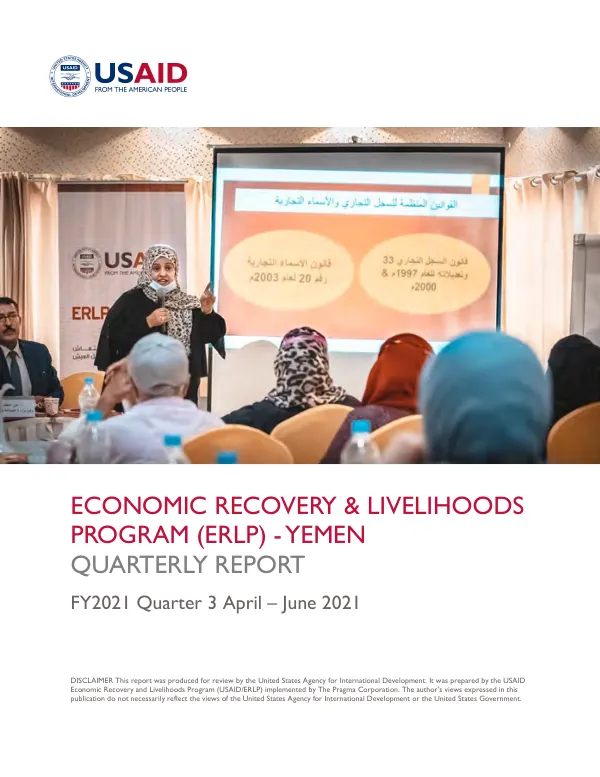
Economic Recovery & Livelihoods Program (ERLP) - Yemen Quarterly Report FY2021 Quarter 3
Sign inUSAID
Economic Recovery & Livelihoods Program (ERLP) - Yemen Quarterly Report FY2021 Quarter 3
The Economic Recovery and Livelihoods Program (ERLP) in Yemen is a USAID-funded initiative aimed at improving the country's economic stability and promoting sustainable livelihoods.
2021 · 650 pages
Sign in to readA free account is required to download.
Abstract
The program is implemented by The Pragma Corporation and focuses on two main components: Improving Macroeconomic Functions of Key Institutions and Improved Microeconomic Conditions. Component 1: Improving Macroeconomic Functions of Key Institutions is designed to strengthen the country's monetary and fiscal policies, as well as its trade facilitation policies. This component includes several sub-components, such as Monetary Policy Development and Implementation, Fiscal Policy Development and Implementation, and Trade Facilitation Policy Development and Implementation. The program aims to improve the country's macroeconomic functions by enhancing the capacity of key institutions, such as the Central Bank of Yemen, and promoting a stable and predictable economic environment. One of the key areas of focus for Component 1 is the development of a more effective monetary policy framework. This includes the implementation of monetary management reforms, foreign reserve and exchange management, and payments system reform. The program also aims to strengthen the country's anti-money laundering and counter-terrorism financing (AML/CFT) framework, as well as its banking supervision and risk management practices. Component 2: Improved Microeconomic Conditions is designed to promote sustainable livelihoods and improve the economic well-being of Yemeni citizens. This component includes several sub-components, such as Support to Small and Medium Enterprises (SMEs), Sustainable Livelihoods, and Workforce Development. The program aims to improve the economic conditions of Yemeni citizens by promoting entrepreneurship, job creation, and access to finance. One of the key areas of focus for Component 2 is the development of SMEs. This includes the provision of technical assistance, training, and access to finance for SMEs, as well as the promotion of a business-friendly environment. The program also aims to improve the country's agricultural sector by promoting sustainable livelihoods and improving access to markets. The ERLP program has made significant progress in its first quarter, with several key achievements reported. These include the development of a new monetary policy framework, the implementation of anti-money laundering and counter-terrorism financing reforms, and the provision of technical assistance to SMEs. The program has also made significant progress in its geographic coverage, with activities reported in several governorates across the country. Overall, the ERLP program is an important initiative aimed at promoting economic stability and sustainable livelihoods in Yemen. The program's focus on improving macroeconomic functions and promoting microeconomic conditions is critical to the country's economic development and stability.