USAID DEC
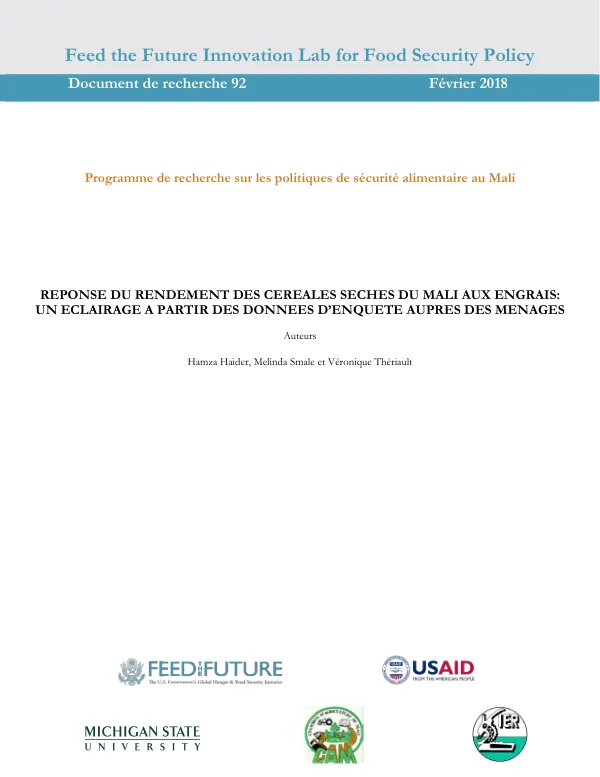
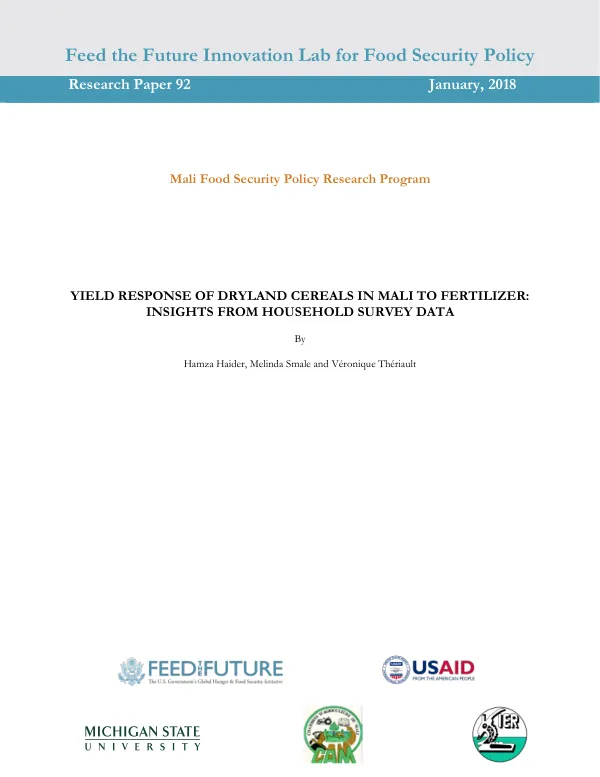
Yield Response of Dryland Cereals in Mali to Fertilizer: Insights from Household Survey Data
Sign inINTERNATIONAL FOOD AND POLICY RESEARCH INSTITUTE
Yield Response of Dryland Cereals in Mali to Fertilizer: Insights from Household Survey Data
Mali's agricultural sector plays a crucial role in the country's economy, with over 60% of the population living in rural areas and half of them living below the national poverty line.
2018 · 47 pages
Sign in to readA free account is required to download.
Abstract
Most rural people depend on agriculture as their main source of livelihood, with dryland cereal crops such as maize, millet, and sorghum accounting for a significant portion of cultivated land. Despite the release of improved varieties, millet and sorghum yields have stagnated, while national average maize yields have risen from 1.4 t/ha in 2001/05 to 2.3 t/ha in 2010/15. The use of mineral fertilizer has been identified as a key factor in stagnating productivity in dryland cereals in Sub-Saharan Africa. In 2008, the Malian government reinstated an input subsidy program to improve access to fertilizer and boost cereal productivity. However, the effectiveness of nitrogen fertilizer in increasing dryland cereal crop yields in Mali is a topic of ongoing research. This study explores the effectiveness of nitrogen fertilizer in increasing dryland cereal crop yields in Mali using household survey data from the LSMS-ISA and a Sudan-Savanna dataset. The study finds that there is little effect of nitrogen fertilizer use on crop yields when using simple econometric analysis. However, when accounting for the endogeneity of fertilizer use, the study finds yield response rates that are within the range reported in the literature. The study also finds that sorghum yields have a lower response to fertilizer than maize yields, and that dryland cereal yield responses to fertilizer are stronger in the Sudan Savanna region than nationwide. Soil texture and practices, such as anti-erosion structures, affect both yields and estimated effects of fertilizer. The study also highlights the importance of promoting balanced use of fertilizers, including phosphorus, to increase agricultural productivity. The study uses a household fixed effects model to estimate the effect of nitrogen fertilizer on dryland cereal yields. The results show that the use of nitrogen fertilizer is associated with a significant increase in maize yields, but not in millet or sorghum yields. The study also finds that the effect of nitrogen fertilizer on yields is stronger in the Sudan Savanna region than in other regions. The study's findings have important implications for agricultural policy in Mali. The results suggest that promoting the use of nitrogen fertilizer, particularly in the Sudan Savanna region, could help to increase maize yields and improve food security. However, the study also highlights the need to promote balanced use of fertilizers, including phosphorus, to increase agricultural productivity. The study's methodology involved collecting data from a household survey in Mali, which included information on fertilizer use, crop yields, and other relevant variables. The study used a household fixed effects model to estimate the effect of nitrogen fertilizer on dryland cereal yields, while controlling for other factors that may affect yields. The study's results are consistent with previous research on the effectiveness of nitrogen fertilizer in increasing crop yields in Sub-Saharan Africa. However, the study's findings also highlight the importance of considering the specific context and agroecological factors that affect fertilizer use and crop yields in Mali. Overall, the study provides valuable insights into the effectiveness of nitrogen fertilizer in increasing dryland cereal crop yields in Mali. The study's findings have important implications for agricultural policy in Mali and highlight the need to promote balanced use of fertilizers to increase agricultural productivity.