USAID DEC
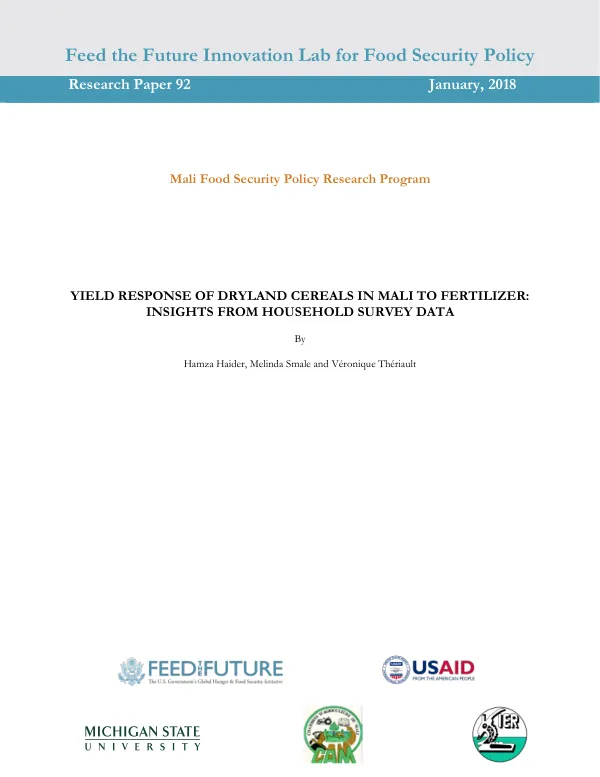
REPONSE DU RENDEMENT DES CEREALES SECHES DU MALI AUX ENGRAIS: UN ECLAIRAGE A PARTIR DES DONNEES D’ENQUETE AUPRES DES MENAGES
Sign inINTERNATIONAL FOOD AND POLICY RESEARCH INSTITUTE
REPONSE DU RENDEMENT DES CEREALES SECHES DU MALI AUX ENGRAIS: UN ECLAIRAGE A PARTIR DES DONNEES D’ENQUETE AUPRES DES MENAGES
The agricultural sector in Mali plays a crucial role in the country's economy, with over 60% of the population living in rural areas and relying on agriculture as their primary source of income.
2018 · 53 pages
Sign in to readA free account is required to download.
Abstract
However, the majority of rural populations live below the poverty line, highlighting the need to increase agricultural productivity to reduce poverty. This article explores the effectiveness of nitrogen fertilizer in increasing yields of dry cereals in Mali. Using the LSMS-ISA dataset and a set of data from the Sudanian Savanna, a simple econometric analysis suggests that the use of nitrogen fertilizers has little effect on crop yields. However, when considering the endogeneity of fertilizer use, the study finds response rates of yields that fall within the margin indicated in the literature. As expected, the response of sorghum yields to fertilizers is weaker than that of maize yields. The response of dry cereal yields to fertilizers is stronger in the Sudanian Savanna (sample) than in the national dataset, highlighting the importance of agro-ecological factors and the agricultural system. The study finds that soil texture and management practices (anti-erosion structures) affect both yields and estimated fertilizer effects. The study also finds that phosphorus is a constraint that hinders the improvement of agricultural productivity. Although the literature primarily focuses on understanding the use of nitrogen fertilizers, it is essential to promote balanced fertilizer use to allow for the availability of other complementary nutrients in the soil. The study uses a combination of data from the LSMS-ISA and the Sudanian Savanna to analyze the response of dry cereal yields to nitrogen fertilizer application. The analysis includes a range of variables, including fertilizer use, soil type, and management practices. The study finds that the response of dry cereal yields to nitrogen fertilizer application is influenced by a range of factors, including soil texture, management practices, and phosphorus availability. The study's findings have implications for agricultural policy and practice in Mali. The results suggest that a balanced approach to fertilizer use is necessary to improve agricultural productivity and reduce poverty. The study also highlights the importance of considering agro-ecological factors and the agricultural system in developing effective agricultural policies. The study uses a range of statistical methods, including econometric analysis and descriptive statistics, to analyze the data. The study's results are presented in a series of tables and figures, which provide a detailed overview of the study's findings. The study's conclusions are based on a thorough analysis of the data and are supported by a range of evidence. The study's methodology is based on a combination of data from the LSMS-ISA and the Sudanian Savanna. The study uses a range of variables, including fertilizer use, soil type, and management practices, to analyze the response of dry cereal yields to nitrogen fertilizer application. The study's results are presented in a series of tables and figures, which provide a detailed overview of the study's findings. The study's conclusions are based on a thorough analysis of the data and are supported by a range of evidence. The study's results are presented in a clear and concise manner, making it easy to understand the study's findings. The study's methodology is based on a combination of data from the LSMS-ISA and the Sudanian Savanna, which provides a comprehensive overview of the study's findings. The study's results are presented in a series of tables and figures, which provide a detailed overview of the study's findings. The study's conclusions are based on a thorough analysis of the data and are supported by a range of evidence. The study's methodology is based on a combination of data from the LSMS-ISA and the Sudanian Savanna, which provides a comprehensive overview of the study's findings.