CATHOLIC RELIEF SERVICES ORGANIZATION
Youth Mental Health and Psychosocial Support: Considerations for Youth Employment
Youth employment programming helps youth develop the skills and knowledge to succeed in the job market.
2021 · 6 pages
Sign in to readA free account is required to download.
Abstract
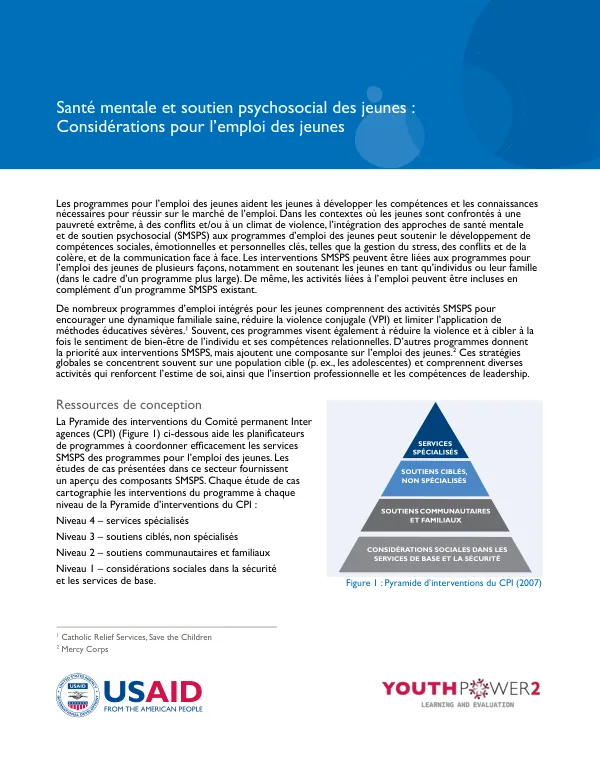
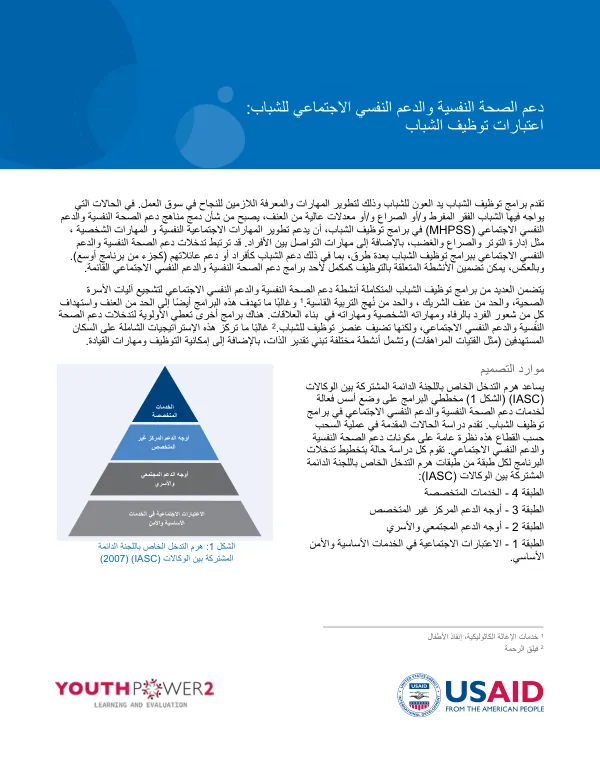
Integrating mental health and psychosocial support (MHPSS) approaches into youth employment programs can support the development of key social-emotional and soft skills, such as stress, conflict, and anger management, as well as interpersonal communication skills. MHPSS interventions may be connected to youth employment programming in several ways, including support for youth as individuals or their families, or employment-related activities as a complement to an existing MHPSS program. Many integrated youth employment programs include MHPSS activities to encourage healthy family dynamics, reduce intimate partner violence (IPV), and limit harsh parenting approaches. These programs often aim to reduce violence and target both the individual's sense of well-being and his or her interpersonal and relationship skills. Other programs prioritize MHPSS interventions but add a youth employment component. These holistic strategies often focus on a target population, such as adolescent girls, and include various activities that build self-esteem, employability, and leadership skills. The Inter-Agency Standing Committee (IASC) Intervention Pyramid provides a framework for effectively layering MHPSS services in youth employment programming. The pyramid consists of four layers: specialized services, focused non-specialized supports, community and family supports, and social considerations in basic services and security. Each layer represents a different level of intensity and scope of MHPSS interventions. The table below provides illustrative activities and how they relate to UNICEF's dimensions of well-being and the four domains of USAID's Positive Youth Development (PYD) Framework. The activities include delivering a weekly cognitive behavioral therapy (CBT) group-based curriculum to adolescents, structured multi-national group activities that help adolescents become more engaged with their emotions and develop empathy, and youth peer coaches and mentors trained in job-readiness skills. The case examples presented in this sector pull-out include Advancing Adolescents developed by Mercy Corps and implemented in Jordan and Syria, and the "I am READY" curriculum developed by Catholic Relief Services (CRS) and implemented in the Northern Triangle of Central America. The Advancing Adolescents program applies the Profound Stress Attunement (PSA) framework, which focuses on the neurological-response impacts of prolonged stress. The program delivers interventions through lay coaches who receive training on how stress physiology affects brain function and how to facilitate experiential learning. The impact evaluation on Advancing Adolescents found that participating adolescents had increased social connectedness, a sense of safety and security, future thinking, and gender equality. The evaluation also showed that the strength of the impact seen in participants was directly related to the strength of the relationships that the adolescents established with their coaches. Following the successful randomized control trial, Mercy Corps added an employment component to the program, which found no significant impact on employability among participants, though well-being continued to increase. The "I am READY" curriculum is a cognitive behavioral therapy-informed curriculum that covers the development of intrapersonal and interpersonal skills. The curriculum has been used in El Salvador, Guatemala, and Honduras with youth in schools, other development programs, and prisons. The curriculum helps program participants recognize and manage thoughts, feelings, and behaviors, and has been found to be effective in working with highly distressed populations and in reducing violent behaviors among juvenile and adult offenders. Table 2 provides illustrative indicators for measuring the impact of MHPSS interventions integrated into violence prevention, peace, and security programming. The indicators are grouped by the measurement area and sector, and the reference key identifies the source for each indicator.