GOVERNMENT OF ETHIOPIA
How USAID is Preparing and Responding Globally to El Niño
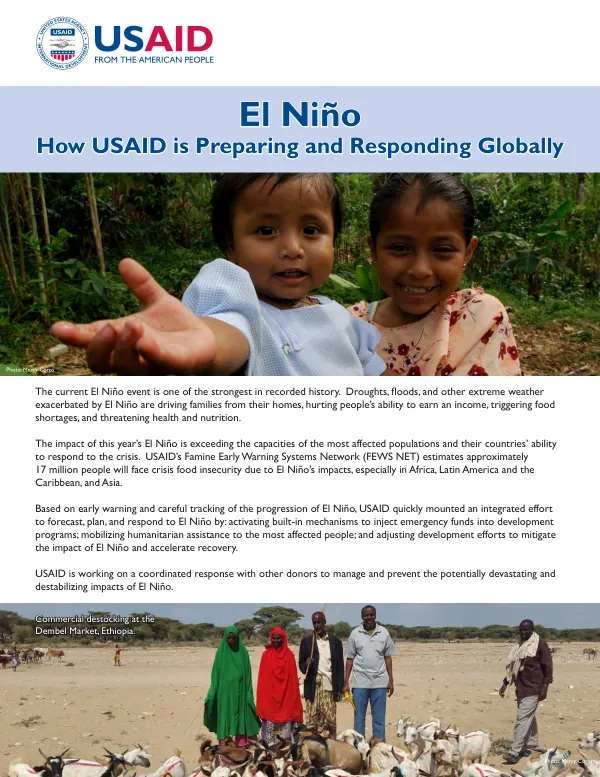
The current El Niño event is one of the strongest in recorded history, resulting in droughts, floods, and other extreme weather conditions that are exacerbating food shortages, threatening health and nutrition, and driving families from their homes.
2016 · 2 pages
Sign in to readA free account is required to download.
Abstract
Approximately 17 million people are expected to face crisis food insecurity due to El Niño's impacts, particularly in Africa, Latin America and the Caribbean, and Asia. USAID has mounted an integrated effort to forecast, plan, and respond to El Niño by activating built-in mechanisms to inject emergency funds into development programs, mobilizing humanitarian assistance to the most affected people, and adjusting development efforts to mitigate the impact of El Niño and accelerate recovery. The agency is working on a coordinated response with other donors to manage and prevent the potentially devastating and destabilizing impacts of El Niño. In Ethiopia, the Government's early response has been critical to mitigate the worst impacts of El Niño, but more than 10 million people will face crisis food insecurity due to the event, accounting for over 60 percent of those impacted globally. The U.S. Government has provided $435 million in food, nutrition, water, sanitation, and hygiene support since October 2014, mobilizing 271,000 metric tons of food to feed 4 million people in Ethiopia. In Southern Africa, USAID has invested $18 million since 2014 in disaster risk reduction programs and contributed $97 million in food assistance to meet immediate needs and address chronic hunger. In Guatemala, Honduras, and El Salvador, USAID provided more than $15 million in food assistance to drought-affected populations, supporting soil conservation and rainwater harvesting, and establishing savings and loan programs that can serve as a safety net. In Haiti, USAID collaborates with the government to address the immediate food needs of over 14,000 households through an electronic food voucher-based safety net system. In Indonesia, drought has made it difficult to fight fires raging across the country, where slash and burn practices prevail with weak enforcement. Nearly half a million people are suffering from acute respiratory infection due to toxic haze caused by the fires. USAID has provided $3 million in "clean air" shelters and firefighting equipment and technical assistance to support the Indonesian government's efforts to combat the fires.
Related documents