INTERNATIONAL YOUTH FOUNDATION
Youth:Work Mexico, Phase II Quarterly Performance Report: January – March 2015
Youth:Work Mexico, Phase II, is a cooperative agreement between USAID/Mexico and the International Youth Foundation.
2015 · 45 pages
Sign in to readA free account is required to download.
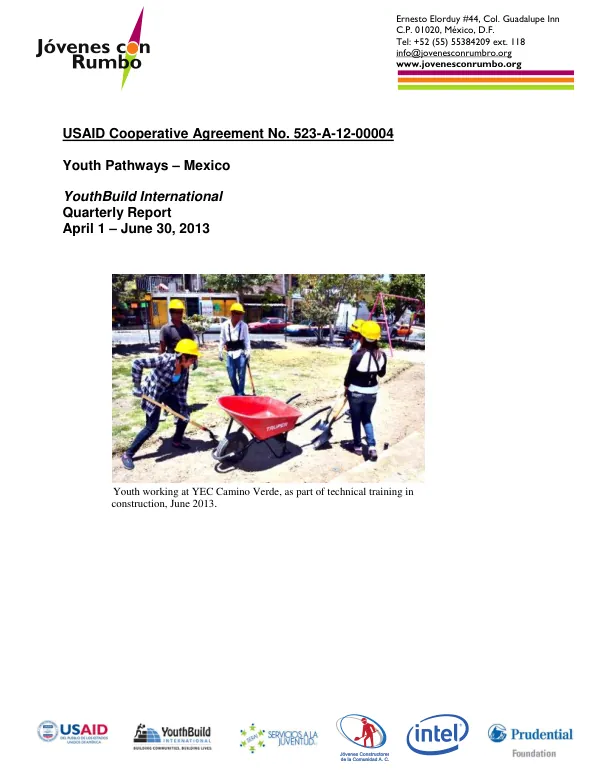
Abstract
The program aims to build resilient communities in Ciudad Juarez and Tijuana by creating safe spaces for disadvantaged young people, strengthening and expanding after-school and summer programs, and preparing Mexican youth for viable futures through self or salaried employment. The target population is youth between the ages of 6-28 who lack the education, skills, and connections to secure decent entry-level work. They typically live in communities that are highly prone to violence and are vulnerable to recruitment by gangs or organized crime groups. The program focuses on youth who are at risk of dropping out of school or have dropped out of the formal education system prior to completing middle school or high school, are employed in precarious conditions or are unemployed, and are living in poverty in specific geographic areas with critical violence problems. The program's goal is to leverage private sector resources and expertise, and to increase community involvement, in providing at-risk youth in Ciudad Juarez and Tijuana with programs to help them stay in school and access the job market, while equipping them with the education and life skills necessary to become positive role models within the workforce, their families, and their communities. In the first phase of the program, 8,947 young people were reached, of which 1,454 young people participated in the employability programs designed and delivered by IYF in Ciudad Juarez and supervised by IYF in Tijuana. The goal of Phase II of YWM is to transfer capacity and ownership to Mexican institutions so that they can manage, deliver, and sustain the YWM employability model to the same target population of youth without dependency on IYF and USAID resources. Phase II activities focus on two objectives: consolidating the YWM employability model in Ciudad Juarez and Tijuana, and building capacity of local institutions to implement and sustain the employability model. The expected results include training 500 young people in employability and supporting them with job placement and career guidance services, with 70% of the training graduates either returning to school or training or securing employment, measured at 3-6 months after graduation. In the January-March 2015 quarter, significant progress was made in Ciudad Juarez and Tijuana. In Ciudad Juarez, 62 youth from Cohort 10 graduated the seven-week employability training workshop, and received a total of 4 months of on-the-job counseling and job placement support. An external evaluation of Cohort 9 found a significant increase in the number of youth working or studying after the program, as well as a significant decrease in the number of "inactive" youth. The evaluation also found that the great majority of youth believed they were less likely to engage in delinquent or harmful behaviors after going through the YWM program. In Tijuana, the pilot cohort results showed that 50 young people were trained in employability, and 88 (84%) of the enrolled youth met the qualifications to graduate the employability workshop. These youth will enter a 4-month period of job placement services where they will receive on-the-job counseling, mentorship, and will be linked to opportunities. The YWM Advisory Committee in Ciudad Juarez was established to ensure the success and continuation of the program. The committee is committed to sustaining youth employability efforts and has solidified its commitment to the program. The program's expansion to Leon Guanajuato is also underway, with local partner DESEM successfully securing funds from a local funder to implement an 11th cohort of youth in Ciudad Juarez, independent from IYF and USAID funding.