USAID. MISSION TO ZIMBABWE
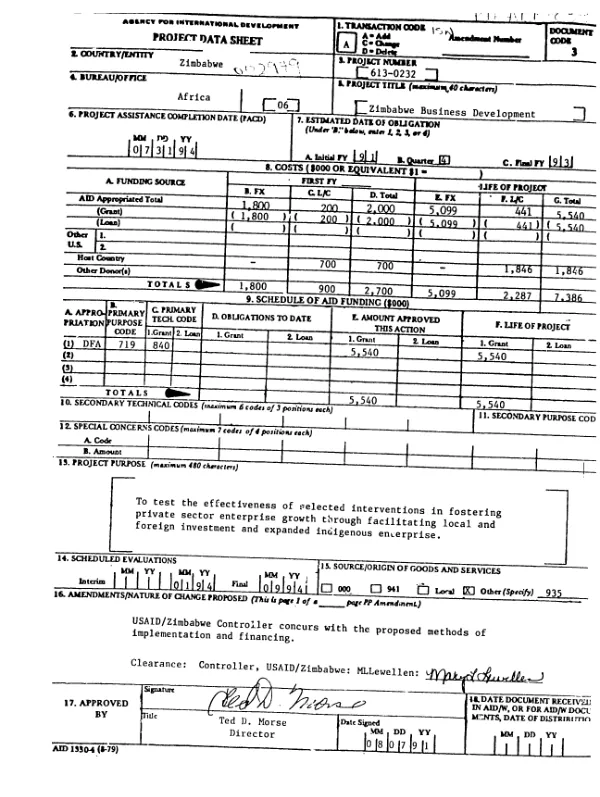
Zimbabwe business development
Pilot project to test strategies to foster private sector growth in Zimbabwe by increasing local and foreign investment and expanding indigenous enterprise.
1991
Sign in to readA free account is required to download.
Abstract
The project will undertake operational testing and analytical studies and will establish a Quick Response Fund to finance activities to support the first two components. Operational testing, which will absorb 75% of the project budget, will consist of three parts. (1) A competitive Export Processing Zone (EPZ) regime will be developed and tested in three phases -- a feasibility study, passing of enabling legislation, and development of implementing regulations and procedures. The private sector will be expected to take a leading role in developing and operating the EPZ. (2) Business linkages between small and large firms (e.g., subcontracting and joint purchasing arrangements) will be developed and tested by up to 15 larger and 20 smaller firms. If the test goes well, a package of TA, needs assessments, and workshops will be provided to the firms. (3) The International Executive Service Corps, which runs the Volunteer Business Advisory Service (VBAS) program, will pilot test the following innovations: outreach to small, black-owned businesses; U.S.-Zimbabwe joint ventures; a regional VBAS; improved client tracking systems; briefing sheets for volunteer executives; and expansion of existing services (IESC"s Volunteer Executive, American Business Linkage Exchange, and Joint Venture Service programs). IESC will also explore the feasibility of establishing a Zimbabwean counterpart. Analytical testing will expand knowledge of the private sector. (1) A baseline study of the small/micro-enterprise sector will be conducted through a buy-in to the GEMINI project (9365448). A workshop to analyze and disseminate survey results will then be followed by longitudinal surveys and subsector analyses. (2) Through a buy-in to a centrally funded project (most likely PEDS -- 9402028), the project will use the Manual for Action in the Private Sector (MAPS) survey technique to prepare a descriptive analysis of the productive sector on the basis of secondary data from 1970-90 and informant interviews. The report will disaggregate the productive sector by subsector, ownership, and geographical location and will examine such areas as employment, international trade, competitiveness, and industrial concentration. A more detailed sector analysis on the basis of survey and focus group activities will be undertaken only if necessary. (3) Supporting research will be conducted on a variety of subjects, e.g., the role of women in productive enterprises in Zimbabwe, social norms, economic deregulation, and the impact of AIDS on economic growth. A Quick Response Fund will provide funds TA, training, or equipment needed to support one of the above components, if necessary, as well as to develop new private sector activities that present themselves during the project"s course.
Related documents
![Zimbabwe enterprise development, 613-0239 : PP [project paper], annexes A - R](https://covers.devme.ai/gen/16589.webp)