USAID'S OFFICE OF U.S. FOREIGN DISASTER ASSISTANCE
Zimbabwe Success Story: Mitigating Cholera in Zimbabwe
The Joint Initiative (JI) is a multi-sectoral program implemented by six relief agencies to combat disaster-induced urban poverty and restore human dignity in cities and high-density suburbs throughout Zimbabwe.
2009 · 3 pages
Sign in to readA free account is required to download.
Abstract
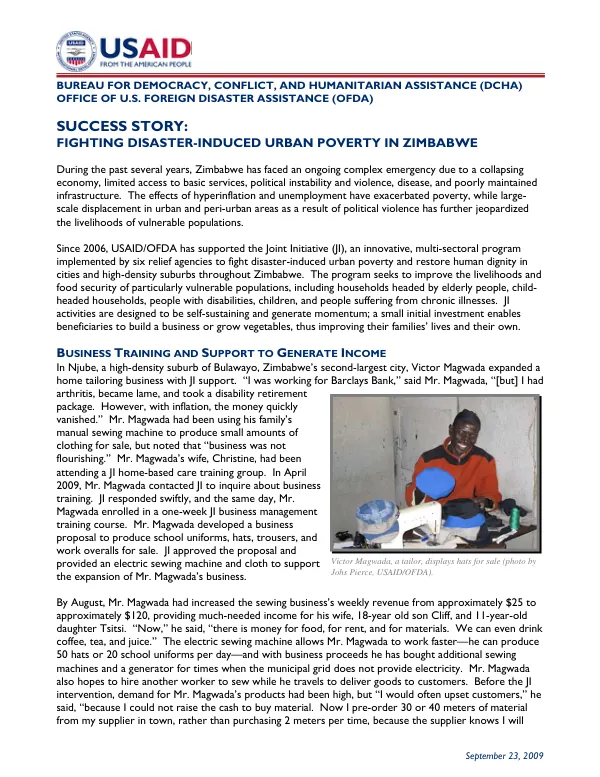
The program, supported by USAID/OFDA since 2006, seeks to improve the livelihoods and food security of vulnerable populations, including households headed by elderly people, child-headed households, people with disabilities, children, and people suffering from chronic illnesses. In Njube, a high-density suburb of Bulawayo, Victor Magwada expanded a home tailoring business with JI support. In addition to agricultural development, JI implemented business training and support to generate income. In Njube, Victor Magwada expanded his home tailoring business with JI support, increasing weekly revenue from approximately $25 to $120. The electric sewing machine allowed Mr. Magwada to work faster, producing 50 hats or 20 school uniforms per day. Business proceeds enabled him to buy additional sewing machines and a generator for times when the municipal grid did not provide electricity. Building market stalls to support income generation was another key component of JI. In the Huriuyadzu hardware market in Chitungwiza, a high-density suburb of Harare, proprietors sell paint, varnish, screws, nails, locks, electric sockets, and other items for household and construction use. JI implementing partners built the market and provided business training to vendors suffering from significant poverty in the wake of displacement and political violence. The market organizing committee, elected by the vendors, ensures that the market remains in good order and generates income for its members. Investment, savings, and lending clubs (ISALs) were also developed through JI to improve livelihoods through microfinance. ISALs allow community members to pool capital for business development and income generation. Members extend loans to one another for a two-week period at 10 percent interest, with all interest serving to increase the size of the fund. According to members, the club has enjoyed a 100 percent repayment rate to date. In addition, each week, the club puts money into a social fund to benefit members with sudden financial needs occasioned by such events as a child's illness. Low-input gardens were also implemented by JI to improve nutrition. The Mudokos, residents of Chitungwiza, were trained in the technique of low-input gardening, which requires minimal acreage. JI partners train beneficiaries in crop management and crop rotation practices to minimize the use of scarce water, allowing beneficiaries to grow a diverse array of vegetables and herbs in backyards. The raised vegetable beds used in low-input gardens retain water better than beds closer to the ground and prevent spoilage during floods. During the program's first phase from 2006 to 2008, JI assisted more than 57,000 beneficiaries in six urban areas throughout Zimbabwe. The second phase of JI operations, scheduled to run until 2011, seeks to deepen the reach of the program and improve the livelihoods and food security of vulnerable populations in Zimbabwe.