ENVIRONMENTAL INCENTIVES, LLC
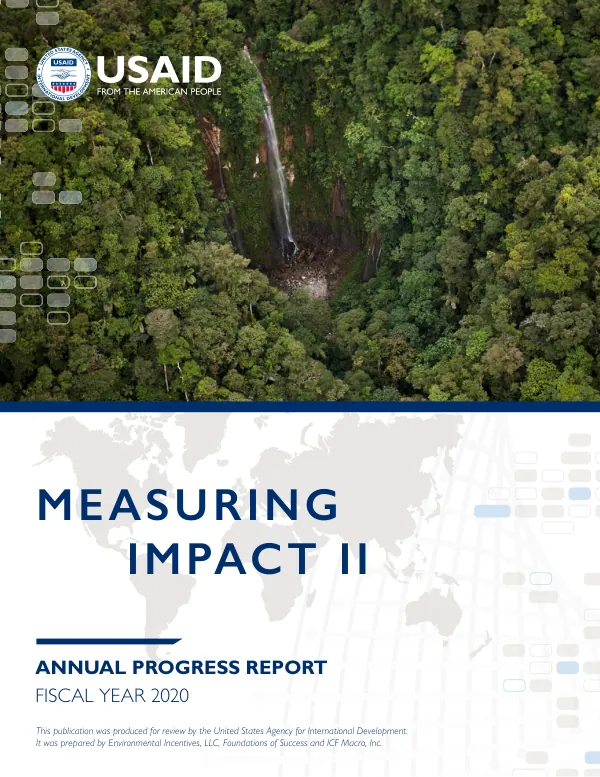
02_MI2 FY2020 Annual Progress Report
Measuring Impact II, a program implemented by Environmental Incentives, LLC, in partnership with Foundations of Success and ICF Macro, Inc., continues to advance USAID's Biodiversity Policy to conserve biodiversity in priority areas and integrate biodiversity as an essential component of human development.
2020 · 44 pages
Sign in to readA free account is required to download.
Abstract
The program aims to strengthen USAID's capacity and motivation to use adaptive management by increasing the use of evidence and learning in USAID programs. In Fiscal Year 2020, Measuring Impact II accomplished several key achievements. The program transitioned from in-person to virtual delivery of support, allowing for the continuation and expansion of field support during the global coronavirus pandemic. This required Measuring Impact II to revamp facilitation approaches and tools to support virtual engagement and to build capacity of the implementation team and USAID counterparts to consistently use and apply new approaches in their work. Measuring Impact II launched six new buy-ins supporting various USAID bureaus and missions, increasing the number of operating units to 14 and totaling $12,028,630 in funding. The program provided technical assistance to 21 Missions, the FAB office, the Bureau for Africa, and the Bureau for Latin America and the Caribbean, supporting 39 biodiversity activities, eight projects, and four strategies. This support influenced more than $320 million dollars in investments in biodiversity and integrated programming in the Agency. Measuring Impact II delivered 51 Program Cycle support workshops, including strategy designs, project and activity designs, activity start-ups, and project and activity pause and reflect events. The program also helped USAID staff design or implement four project- or activity-level evaluations and assessments. Measuring Impact II deepened FAB and MI2 staff's understanding of incentives and barriers that influence how USAID staff use adaptive management in biodiversity and integrated programming through the completion of the Stakeholder Needs Assessment. The assessment informed the development of the Stakeholder Engagement Strategy, which pinpoints key audiences and strategies to engage them to improve the enabling conditions for adaptive management in biodiversity programming. In partnership with the private sector, Measuring Impact II designed transformational solutions to cross-sectoral challenges in biodiverse landscapes in Africa through the advancement of the USAID Health, Ecosystems, and Agriculture for Resilient, Thriving Societies (HEARTH) initiative. Measuring Impact II helped USAID and implementing partner staff reassess the programming context in light of the global coronavirus pandemic and to adjust approaches and actions in rapidly changing environments across Africa, Asia, and LAC through 23 pause and reflect workshops. The program expanded the cross-mission learning portfolio by launching four new groups on Marine Conservation and Sustainable Fisheries, Wild Meat, and two LAC regional learning agendas on Combating Conservation Crime and Private Sector Engagement. Measuring Impact II also continued to support the mature learning groups Conservation Enterprises and Combating Wildlife Trafficking. These six learning groups have furthered biodiversity learning in the Agency, providing open space for learning and collaborating, while identifying practical, concrete recommendations to help address information gaps and inform programming decisions. The program completed the Adaptive Management in the Combating Wildlife Trafficking Portfolio: Current Practice and Opportunities assessment, which included insights from both USAID staff and implementing partners working on CWT activities across Asia and Africa. Measuring Impact II co-developed guidance in partnership with FAB and technical experts from the BRIDGE activity, Technically Strong and Politically Savvy: Enhancing Thinking and Working Politically When Practicing the Conservation Standards at USAID. This resource is a supplemental guide to the three Biodiversity How-To Guides developed under Measuring Impact and provides practical advice to biodiversity practitioners for implementing politically-informed programming. The program completed the Office of Forestry and Biodiversity: Assessment of Biodiversity Integration Efforts to help FAB understand the progress of its own biodiversity integration efforts and inform the design of the next generation of biodiversity programming.
Related documents