USAID
10 Ways to Accelerate Mobile Money
The USAID-Citi Mobile Money Accelerator Alliance aims to accelerate the adoption of mobile money to reach the last mile with basic financial services.
2012 · 8 pages
Sign in to readA free account is required to download.
Abstract
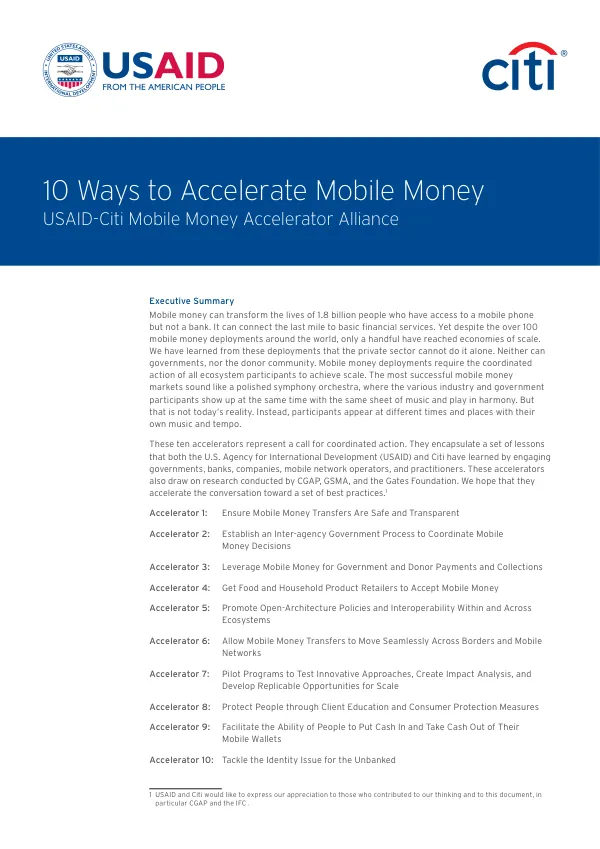
Mobile money has the potential to improve livelihoods, reduce corruption, empower entrepreneurs, and unlock the private sector. The alliance believes that mobile money is critical to financial inclusion and economic development. The alliance has identified ten accelerators to facilitate the coordinated action of all ecosystem participants. The first accelerator, Ensure Mobile Money Transfers Are Safe and Transparent, emphasizes the importance of regulatory frameworks that balance innovation and safety. Government entities and regulatory authorities should work to ensure mobile money regulations strike the right balance between innovation and safety and security. This includes considering regulations such as financial sector regulation and supervision, telecom sector regulation and supervision, and mobile money regulation and supervision. The second accelerator, Establish an Inter-agency Government Process to Coordinate Mobile Money Decisions, highlights the need for coordination among government institutions and the private sector. Mobile money ecosystems include a number of stakeholders within governments, and coordination is critical to striking the right regulatory balance and identifying how governments can accelerate the adoption of mobile money. Governments should have an inter-agency committee process with a chairperson to ensure policy coordination between government institutions internally and with the private sector externally. The third accelerator, Leverage Mobile Money for Government and Donor Payments and Collections, suggests that governments and donor organizations can increase uptake and use of mobile money by paying salaries, social benefits, conditional cash transfers, and pensions through this channel. Large donor organizations can similarly adopt the use of mobile money in their disbursements. This can improve transparency, reduce costs and leakage, and dramatically accelerate the ecosystem forward along the network effect curve toward a tipping point. The alliance also emphasizes the importance of interoperability, which allows mobile money transfers to move seamlessly across borders and mobile networks. This can be achieved through open-architecture policies and interoperability within and across ecosystems. Additionally, the alliance suggests that mobile money agents, merchant acceptance points, retail participants, and participating billing and payment entities must be established to ensure that mobile payments stay in the system to advance financial inclusion. The alliance believes that mobile money has the potential to improve livelihoods, reduce corruption, empower entrepreneurs, and unlock the private sector. By facilitating the coordinated action of all ecosystem participants, the alliance aims to accelerate the adoption of mobile money and reach the last mile with basic financial services.