DEPARTMENT OF ENERGY
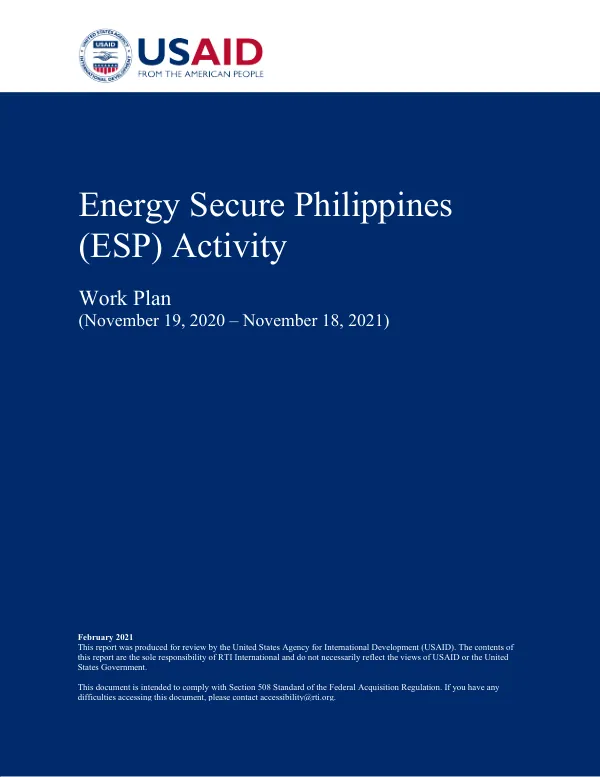
1st Quarterly Performance Report FY 2021: Energy Secure Philippines (ESP) Activity
The Energy Secure Philippines (ESP) Activity is a five-year project implemented by RTI International for the United States Agency for International Development (USAID) Philippines.
2021 · 23 pages
Sign in to readA free account is required to download.
Abstract
The project aims to enhance the security and reliability of the envisioned unified power system in the Philippines. The lead implementing government counterparts are the Department of Energy (DOE) and Energy Regulatory Commission (ERC), which are expected to collaborate closely with national, subnational, and local government units. The ESP Activity supports the Philippines Energy Sector Strategic Directions 2017-2040 and the goals of the United States Government's Asia EDGE (Enhancing Development and Growth Through Energy) Initiative. The overall objective of the ESP Activity is to mobilize at least $750 million worth of private sector investments for the country's energy sector, and to support efforts leading to additional new generation capacity of at least 500 megawatts. The project also envisions providing a total of $ in grants to encourage private sector participation and/or collaboration with local non-governmental entities in the implementation of interventions. The ESP Activity will promote the development and implementation of competitive and transparent processes, incentivizing private investment, boosting the utilization of new and advanced energy technologies, increasing resilience to natural and human-induced shocks, and promoting a secure, stable, diversified, and modern Philippine energy sector. The project will work with several local government units across the country guided by the Local Energy Code jointly issued by the Departments of Local Government and Energy and the full implementation of the Energy Virtual One Stop Shop (EVOSS) Act. The ESP Activity will be implemented according to three major objectives, and organized under sub-objectives as described below: 1) Improve the performance of electric utilities; 2) Enhance the resilience of the energy sector; and 3) Promote the development and implementation of advanced energy technologies. The project will mobilize private sector investments, deploy modern energy technology, and support policy reforms for a more competitive energy sector that can drive future economic growth and social development. The ESP Activity will work closely with the Department of Energy (DOE), Energy Regulatory Commission (ERC), and other government agencies to achieve its objectives. The project will also collaborate with local and international companies to provide technical expertise and support the implementation of energy interventions. The ESP Activity will be implemented in accordance with the USAID Philippines Mission's new Country Development Cooperation Strategy 2019-2024 (CDCS), which supports US initiatives to advance the Indo-Pacific Vision and the Asia EDGE Initiative. The ESP Activity will focus on advancing inclusive economic growth and resilient development through increased private investment, in order to promote advanced technology deployment and boost the energy sector's resilience to shocks and stresses. The project will also support the development and implementation of, as well as adherence to existing laws related to competitive and transparent processes, incentivizing private investment, boosting the utilization of new and advanced energy technologies, increasing resilience to natural and human-induced shocks, and promoting a secure, stable, diversified, and modern Philippine energy sector. The ESP Activity will be implemented in several phases, with the first quarter performance report covering tasks completed from November 19 through December 31, 2020. The report provides an overview of the project's progress, achievements, and challenges during the first quarter of FY2021. The report also highlights the project's objectives, scope, and expected outcomes, as well as the key stakeholders involved in the project. The ESP Activity is expected to have a significant impact on the energy sector in the Philippines, promoting the development and implementation of advanced energy technologies, increasing resilience to natural and human-induced shocks, and promoting a secure, stable, diversified, and modern Philippine energy sector. The project will also contribute to the achievement of the USAID Philippines Mission's new Country Development Cooperation Strategy 2019-2024 (CDCS), which supports US initiatives to advance the Indo-Pacific Vision and the Asia EDGE Initiative.
Related documents