USAID DEC
Knowledge Brief: Lessons Learned on the Deployment of Distributed Photovoltaics (DPV) in Southeast Asia
Sign inTETRA TECH
Knowledge Brief: Lessons Learned on the Deployment of Distributed Photovoltaics (DPV) in Southeast Asia
The deployment of distributed photovoltaics (DPV) in Southeast Asia has gained significant momentum in recent years, driven by the region's growing energy demand and increasing focus on clean energy production.
2023 · 13 pages
Sign in to readA free account is required to download.
Abstract
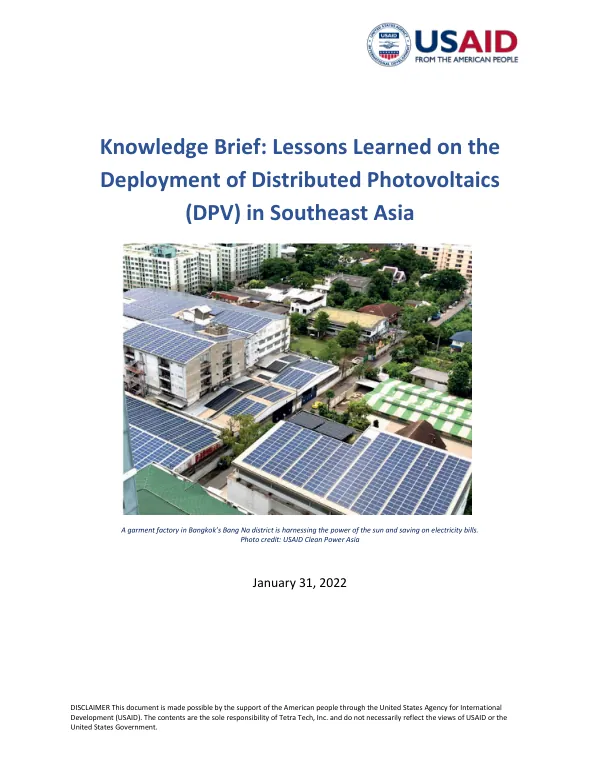
Southeast Asia has significant potential to increase access to renewable energy, with solar power being a promising energy source due to its ability to inexpensively generate power during the day when demand is high. DPV involves distribution-level grid-connected, typically rooftop solar arrays that are co-located with customer loads on private and commercial property. This approach provides the benefits of solar power, such as system flexibility and resilience, while reducing electricity costs without the significant physical footprint required by utility-scale solar installations. DPV installations are generally smaller-scale systems that offset some or all of a customer's monthly utility bill and, if local regulations allow, can enable export of excess electricity back to the grid. USAID efforts have supported the modernization of Southeast Asia's solar PV market by improving DPV connectivity, reforming policy, and engaging the private sector in the energy market. USAID has supported multiple projects in Southeast Asia in the deployment of DPV over the past decade, utilizing a common holistic three-pillar approach: providing policymakers and regulators with tools to expand DPV use, helping utilities understand the impact of DPV on the grid and revenue streams, and building stakeholder knowledge of the benefits of using DPV. The Philippines, Thailand, and Indonesia are among the countries in Southeast Asia that have benefited from USAID's DPV deployment efforts. In the Philippines, USAID Clean Power Asia supported the government in conducting a DPV economic and technical impact analysis, which reviewed policy and regulations to determine areas for improvement and streamline processes. The results of the analysis were incorporated into the Philippines Department of Energy's draft Department Circular Promulgating Policies to Enhance the Net-Metering Program for Renewable Energy and Energy Regulatory Commission's Amended Net Metering Rules. In Thailand, USAID Clean Power Asia conducted utility review and rate impact analyses that contributed to a draft DPV self-consumption policy in 2018 with a proposed target of 300 MW. Although the draft policy did not pass, it influenced Thailand's Power Development Plan 2018-2037, which was officially announced in April 2019 with a solar rooftop target of 100 MW per year and up to 1 gigawatt per year. In Indonesia, USAID Indonesia Clean Energy Development II conducted a DPV photovoltaic economic impact analysis that resulted in the development and issuance of the DPV regulation by the Ministry of Energy and Mineral Resources. The deployment of DPV in Southeast Asia has achieved significant milestones, with a total of 9,733.3 megawatts installed under completed USAID projects in the region. The projects have targeted the three priority areas of Clean EDGE Asia: energy security to support growing economies, energy for sustainable development, and decarbonization to reach a carbon-neutral future. USAID's efforts to promote DPV deployment have attracted private sector investments, advanced the adoption of clean energy technology, and enhanced policy reforms, ultimately contributing to the region's transition to a cleaner and more sustainable energy future.