USAID DEC
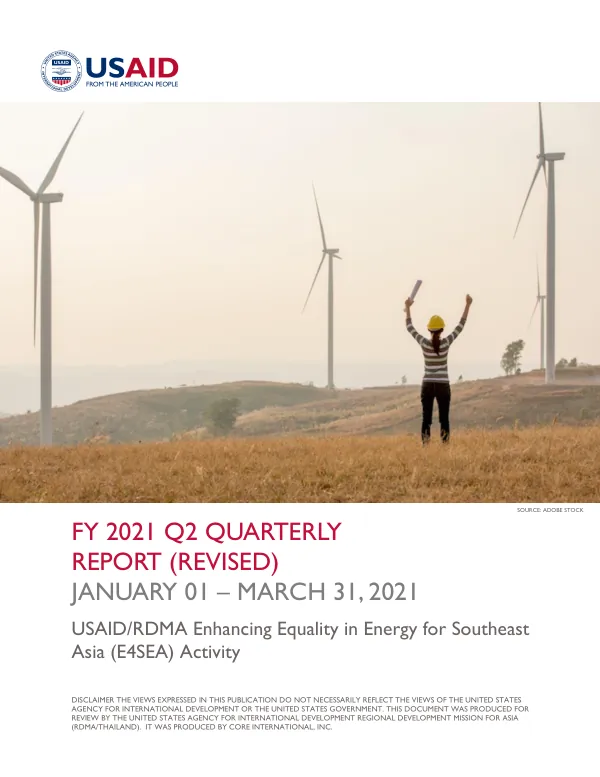
Enhancing Equality in Energy for Southeast Asia (E4SEA) Activity Quarterly Performance Report
Sign inCORE INTERNATIONAL, INC.
Enhancing Equality in Energy for Southeast Asia (E4SEA) Activity Quarterly Performance Report
The Enhancing Equality in Energy for Southeast Asia (E4SEA) Activity is a program aimed at promoting gender equality in the energy sector in Southeast Asia.
2021 · 92 pages
Sign in to readA free account is required to download.
Abstract
The activity is implemented by USAID's Regional Development Mission for Asia (RDMA/Thailand) and is funded by the United States Agency for International Development (USAID). The program aims to address the underrepresentation of women in the energy sector and promote gender equality in the workplace. The activity focuses on three key outcomes: increasing workplace diversity, improving inclusive workplace environments, and expanding equitable promotion opportunities. To achieve these outcomes, the activity focuses on five objectives: collecting country-level data, mapping existing programs and documenting key challenges and lessons learned, engaging energy stakeholders to document core challenges in advancing women's engagement and leadership, reversing negative perceptions about women and girls in energy sector jobs, and improving data-driven decision-making tools to track gender data and outcomes. The activity has made significant progress in the first quarter of 2021. The team has established a strong coordination mechanism with the USAID Mission in Indonesia and the Sinar IP (Tetra Tech), the USAID Mission in the Philippines and the ESP IP (RTI International), and the USAID Mission in Lao PDR and the LES IP (Numark Associates). The team has also made progress in engaging universities and vocational schools to participate in the activity's in-depth interviews (IDIs) and has conducted IDIs with other stakeholders and additional meetings. The activity has also made progress in designing the composition of focus groups and the baseline citizen survey. The team has also made progress in removing gender-related constraints and has pursued new opportunities to create greater gender equity. The activity has also made progress in completing interventions and progress towards results. The activity has also made progress in implementing the communications and outreach plan. The team has developed a comprehensive communications strategy and has implemented a social media campaign to raise awareness about the importance of gender equality in the energy sector. The activity has also made progress in engaging energy employers and has conducted IDIs with energy employers to document their experiences and challenges. The activity has also made progress in designing and conducting IDIs with universities and vocational schools. The team has developed a comprehensive research design and has conducted interviews with key stakeholders. The activity has also made progress in designing the baseline citizen survey and has developed a comprehensive survey instrument. The activity has also made progress in removing gender-related constraints. The team has identified several barriers to women's participation in the energy sector, including lack of education and training, lack of access to training and education, and lack of access to training and education. The team has also identified opportunities to address these barriers, including providing training and education to women, providing training and education to employers, and providing training and education to policymakers. The activity has also made progress in pursuing new opportunities to create greater gender equity. The team has identified several opportunities to increase women's participation in the energy sector, including partnering with organizations that work with women, providing training and education to women, and providing training and education to employers.