USAID
1st Quarterly Report (March – June 2012)
The Agrodealer Trade Across Borders (ATAB) project, implemented by AGMARK-KENYA, aims to enhance cross-border trade in grains among East African countries.
2012 · 32 pages
Sign in to readA free account is required to download.
Abstract
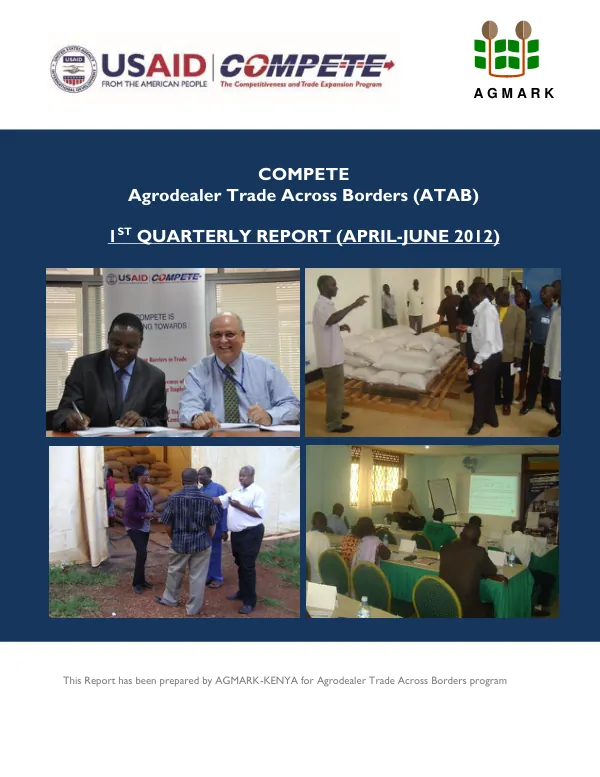
The project is funded by USAID's Competitiveness and Trade Expansion Program (COMPETE) under Cooperative Agreement No. 623-LA-10-00004. During the first quarter of program implementation, from April to June 2012, strong progress was made towards achieving program deliverables. A contract agreement signing ceremony was held at the Compete Nairobi offices, and a Project Officer, an Accountant, and a part-time Monitoring and Evaluation (M&E) Officer were contracted to the project. AGMARK launched the project on April 12, 2012, at the Golf Course Hotel in Kampala, Uganda, with a total attendance of 30 people from the East Africa region. The event brought together agrodealers engaging in grain trade, the Ministry of Agriculture Animal Industry and Fisheries (MAAIF), AGMARK, COMPETE, USAID, UNADA, financial institutions, commercial trainers, the Eastern Africa Grain Council (EAGC), the International Fertilizer Development Centres (IFDC), Non-Governmental Organizations (NGOs), and Area Cooperative Enterprises (ACEs). Trips were made to Tanzania and Uganda to identify stakeholders to collaborate with in the program and to sensitize them about the ATAB project. A total of nine training modules were reviewed and developed, covering topics such as grain aggregation and bulking, warehouse management, sanitary and phytosanitary standards, grain quality standards, harmonized standards, contractual issues and arbitration, marketing costs and margins, marketing and branding, grain export and import regulations, and customs declarations and procedures. Five sessions of agrodealer training were conducted, four in Uganda and one in Tanzania, with a total of 77 agrodealers and dealers in outputs trained. The trainings were attended by 57 males and 20 females, with 18 agrodealers from Tanzania. Through the ATAB project, AGMARK created partnerships with several organizations involved in the agriculture sector, including the Ministry of Agriculture and Forestry, which played a key role in closing and opening the training sessions in all the counties where the trainings were conducted. Key achievements in the first quarter include the development of training materials, agrodealer training in cross-border trade, agrodealer cross-border trade, and agrodealer supply contracts with buyers. A total of 5,143 metric tonnes of grain crossed the border, with 29 agrodealers having supply contracts and a total volume of 42,153 metric tonnes of grain supplied under these contracts. The project has also made significant progress in staffing, with a Project Officer, an Accountant, and a part-time M&E Officer contracted to the project. Project administration, management, and reports are being handled by AGMARK, with the support of staff from various organizations. Challenges in project implementation and lessons learned are discussed in the report, highlighting the need for continued support and collaboration among stakeholders to achieve the project's objectives. Next steps for the project include continued implementation of the training program, expansion of the project to other regions, and strengthening of partnerships with key stakeholders. The project has achieved significant results, including the training of 77 agrodealers and dealers in outputs, the development of 9 training modules, and the facilitation of cross-border trade in grains among East African countries. The project's success is attributed to the strong partnerships established with key stakeholders, including the Ministry of Agriculture and Forestry, the EAGC, the IFDC, and the NGOs.