ABT ASSOCIATES
2012-13 HEALTH, POPULATION, AND NUTRITION FACT SHEET
Malawi is a country facing significant health challenges that hinder its growth and development.
2012 · 1 pages
Sign in to readA free account is required to download.
Abstract
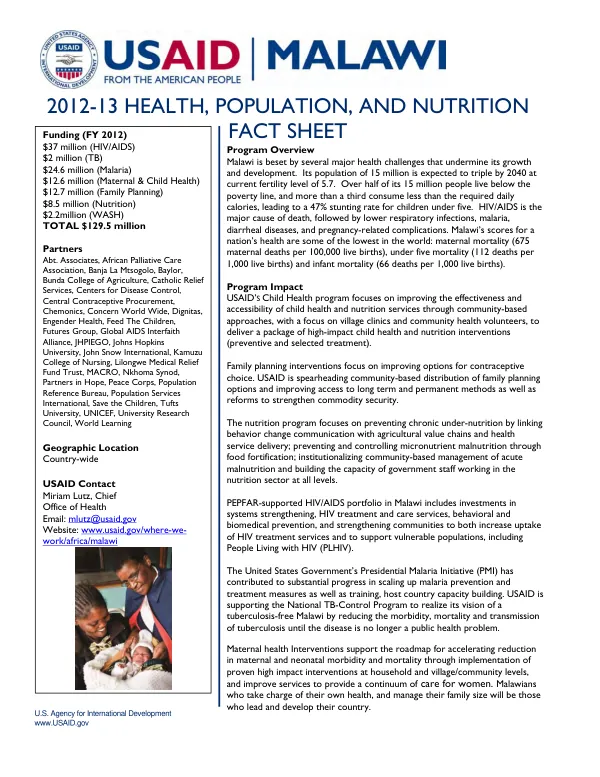
The population of 15 million is expected to triple by 2040 at the current fertility rate of 5.7. Over half of the population lives below the poverty line, and more than a third consumes less than the required daily calories, resulting in a 47% stunting rate for children under five. HIV/AIDS is the major cause of death, followed by lower respiratory infections, malaria, diarrheal diseases, and pregnancy-related complications. Malawi's health scores are among the lowest in the world, with maternal mortality at 675 maternal deaths per 100,000 live births, under five mortality at 112 deaths per 1,000 live births, and infant mortality at 66 deaths per 1,000 live births. The USAID Child Health program focuses on improving the effectiveness and accessibility of child health and nutrition services through community-based approaches. This includes village clinics and community health volunteers delivering a package of high-impact child health and nutrition interventions, such as preventive and selected treatment. Family planning interventions aim to improve options for contraceptive choice, with a focus on community-based distribution of family planning options and improving access to long-term and permanent methods. The nutrition program in Malawi focuses on preventing chronic under-nutrition by linking behavior change communication with agricultural value chains and health service delivery. This includes preventing and controlling micronutrient malnutrition through food fortification, institutionalizing community-based management of acute malnutrition, and building the capacity of government staff working in the nutrition sector. The PEPFAR-supported HIV/AIDS portfolio in Malawi includes investments in systems strengthening, HIV treatment and care services, behavioral and biomedical prevention, and strengthening communities to increase uptake of HIV treatment services and support vulnerable populations. The United States Government's Presidential Malaria Initiative (PMI) has contributed to substantial progress in scaling up malaria prevention and treatment measures, as well as training and host country capacity building. USAID is supporting the National TB-Control Program to reduce the morbidity, mortality, and transmission of tuberculosis until the disease is no longer a public health problem. Maternal health interventions aim to accelerate the reduction in maternal and neonatal morbidity and mortality through the implementation of proven high-impact interventions at household and village/community levels, and improve services to provide a continuum of care for women. The USAID program in Malawi is funded at $129.5 million for FY 2012, with allocations for HIV/AIDS ($37 million), TB ($2 million), malaria ($24.6 million), maternal and child health ($12.6 million), family planning ($12.7 million), nutrition ($8.5 million), and WASH ($2.2 million). The program is implemented in partnership with various organizations, including Abt. Associates, African Palliative Care Association, Banja La Mtsogolo, Baylor, and others. The program operates country-wide, with a focus on improving health outcomes and reducing poverty in Malawi.
Related documents