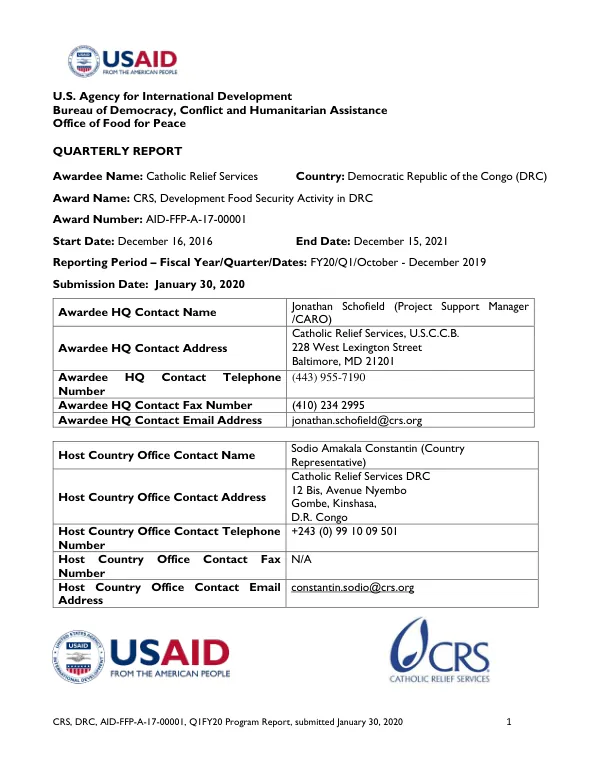
CATHOLIC RELIEF SERVICES ORGANIZATION
Q1FY20 Program Report: CRS, DRC, AID-FFP-A-17-00001
The Development Food Security Activity in the Democratic Republic of the Congo (DRC) is a program implemented by Catholic Relief Services (CRS) in collaboration with the Government of the DRC and other local partners.
2020 · 23 pages
Sign in to readA free account is required to download.
Abstract
The program aims to improve nutrition, food security, and economic well-being for vulnerable households in Eastern Kasai. The geographic focus of the program is on three health zones: Cilundu, Miabi, and Kasansa in the Province of Kasai Oriental. The program goal is to sustainably improve nutrition, food security, and economic well-being for vulnerable households in Eastern Kasai by 2021. The foundational purpose of the program is to empower communities to sustain improvements to food security and nutrition. The program is guided by five strategic purposes, including reducing chronic malnutrition in children under five, improving household inclusive social and economic well-being, and reducing systemic gender barriers to food and nutrition security. During the first quarter of FY2020, Budikadidi, the implementing partner of CRS, continued to work with key stakeholders to deliver services geared toward improving food and nutrition security in the three health zones. The program focused on strengthening the central role of Cellules d'Animation Communautaire (CACs) in community development and empowerment. Budikadidi supported the establishment of 8 water management committees, bringing the total number to 474 targeted villages. The program also worked to improve hygiene and sanitation, including access to potable water, within targeted households. Budikadidi reached households through care groups, with care group Lead Mothers conducting home visits and community sensitization to ensure that key messages related to optimal nutrition and health are adopted by households. The program also supported community members in the implementation and improvement of agricultural and non-agricultural activities, including SILC, Market gardens, Permagardens, improved seeds, promotion of value chain activities, reforestation, and restoration and protection of natural resources. Integrated phase classification (IPC) projections forecast that 55% of the population in the territory of Miabi will be in IPC Phase 3 or more from January to May 2020. In response, Budikadidi started discussions with key actors, including Save the Children and Medecins d'Afrique, to implement ready-to-use therapeutic foods distributions supported by UNICEF in the territory of Miabi. A concept note is being prepared for submission to USAID/FFP to ensure that the response is well-coordinated and implemented through an emergency perspective. The program also focused on building on the achievements of the previous quarters, ensuring that the local environment favors multi-sectoral development toward food and nutrition security for all community members. Activities related to the environment, seed distribution, and livestock distribution were carried out in close collaboration with the technical services of the provincial government. Joint site visits were planned to strengthen complementarities between all nutrition programs in the province.