USAID DEC
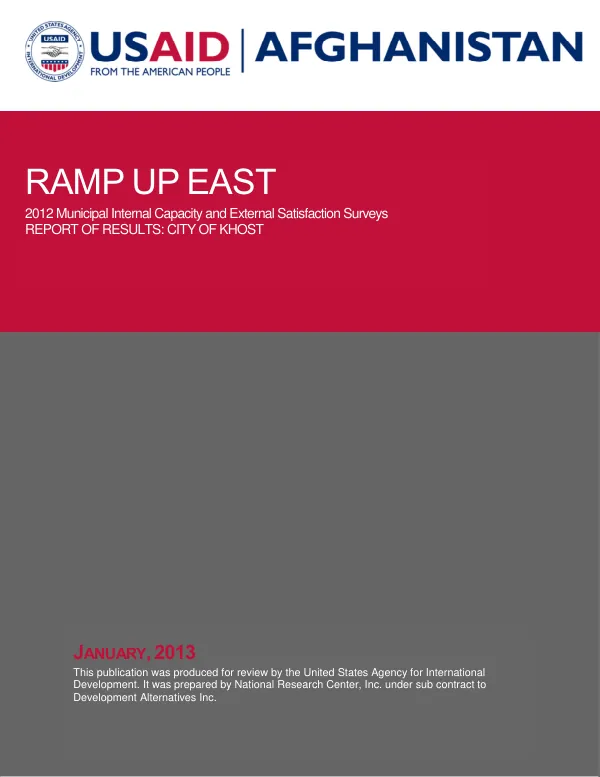
2012 Municipal Internal Capacity and External Satisfaction Surveys: REPORT OF RESULTS: CITY OF KHOST
Sign inDAI
2012 Municipal Internal Capacity and External Satisfaction Surveys: REPORT OF RESULTS: CITY OF KHOST
The City of Khost, located in Eastern Afghanistan, has a population of approximately 120,000 residents.
2013 · 153 pages
Sign in to readA free account is required to download.
Abstract
The city's demographics are characterized by a high percentage of youth, with 45% of the population under the age of 18. The majority of residents, 85%, are ethnic Pashtun, while 10% are ethnic Tajik. The city's economy is primarily driven by agriculture, with a significant portion of the population engaged in farming and livestock production. The city's internal capacity is assessed through various indicators, including general municipal capacity, public works capacity, public finance/financial management capacity, and revenue enhancement capacity. The general municipal capacity is evaluated based on the city's ability to manage its affairs, including the presence of a municipal organization chart, a municipal development plan, and a local economic development plan. The public works capacity is assessed through indicators such as the presence of a public works office, a systematic filing system, and the availability of public works computers and software. The city's public finance/financial management capacity is evaluated based on indicators such as the use of a general ledger, the presence of a procurement system, and the frequency of financial audits. The revenue enhancement capacity is assessed through indicators such as the presence of a revenue enhancement plan, the frequency of revenue collection, and the amount of revenue collected. The city's resident survey indicates that the quality of life in Khost is generally low, with 70% of respondents reporting that they are dissatisfied with the city's services. The city's governance is evaluated based on indicators such as the presence of a municipal council, the frequency of council meetings, and the level of citizen participation in decision-making. The city's women in society indicator shows that women play a significant role in the city's economy, with 60% of women engaged in income-generating activities. However, women's participation in decision-making is limited, with only 20% of council members being women. The city's public works infrastructure is in need of improvement, with 70% of respondents reporting that the city's roads are in poor condition. The city's waste management system is also inadequate, with 80% of respondents reporting that trash is not collected regularly. The city's public finance office infrastructure is also in need of improvement, with 60% of respondents reporting that the office lacks basic equipment and software. The city's budget and planning activities are evaluated based on indicators such as the frequency of budget updates, the presence of a budget and planning manual, and the level of citizen participation in budgeting. The city's financial management capacity is evaluated based on indicators such as the use of a general ledger, the presence of a procurement system, and the frequency of financial audits. The city's revenue enhancement capacity is assessed through indicators such as the presence of a revenue enhancement plan, the frequency of revenue collection, and the amount of revenue collected. Overall, the city of Khost faces significant challenges in terms of its internal capacity, public works infrastructure, and financial management. However, the city also has opportunities for improvement, particularly in terms of its governance and revenue enhancement capacity.
Related documents