USAID DEC
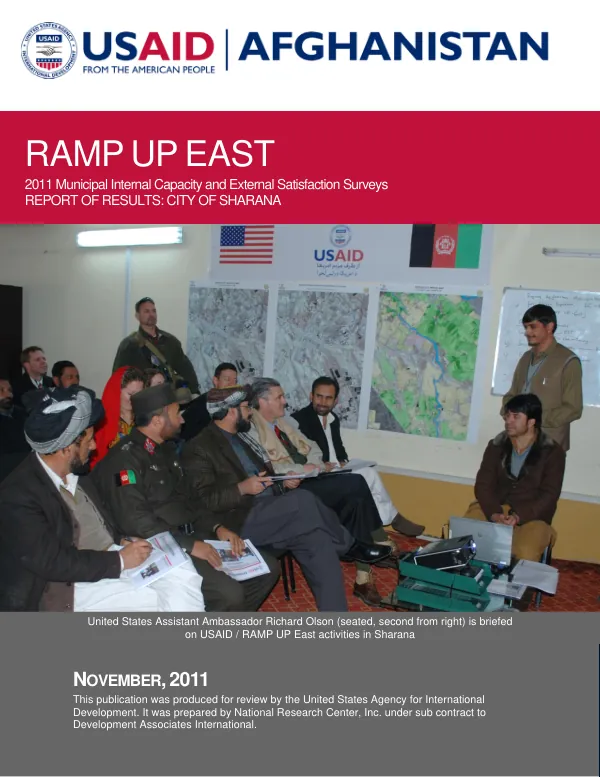
RAMP UP East 2011 Municipal Internal Capacity and External Satisfaction Surveys Report of Results: City of Sharana
Sign inDAI
RAMP UP East 2011 Municipal Internal Capacity and External Satisfaction Surveys Report of Results: City of Sharana
The Regional Afghan Municipalities Program for Urban Populations – Regional Command East (RAMP UP East) was a USAID-funded initiative aimed at enhancing the capacity of municipalities in Eastern Afghanistan.
2011 · 109 pages
Sign in to readA free account is required to download.
Abstract
The program focused on improving internal capacity and external satisfaction in participating cities, including Sharana. Internal capacity assessments were conducted in Sharana, evaluating the city's municipal organization, public works, financial management, and revenue enhancement capabilities. The assessments revealed that the city's municipal organization was well-established, with a clear municipal profile, vision, mission, and goals. The municipal council met regularly, with a frequency of 12 meetings per year, and had a total of 25 employees. Public works capacity was also assessed, with a focus on infrastructure development, maintenance, and service delivery. The city had a comprehensive public works operations and maintenance scheduling document, and regular maintenance was conducted for roads, public parks, and latrines. The city also had a designated dump site and a trash collection plan in place. Financial management capacity was evaluated, with a focus on accounting, budgeting, and revenue collection. The city had a systematic filing system for financial management, and used a general ledger for financial transactions. The city also had written procedures for disbursing cash and recording disbursements. Revenue enhancement capacity was assessed, with a focus on revenue collection, fees, and taxes. The city had a revenue system type, with standard written procedures for recording revenues. The city collected various fees and taxes, including property taxes and business licenses. The revenue enhancement department had a total of 10 employees, and used a computer network and access system for financial transactions. A resident survey was also conducted in Sharana, evaluating the quality of life, services, governance, and women's participation in society. The survey revealed that residents were generally satisfied with the city's services, including water supply, sanitation, and healthcare. However, there were concerns about the city's governance, with many residents feeling that the municipal council was not responsive to their needs. Women's participation in society was also evaluated, with a focus on their involvement in decision-making processes and access to education and employment opportunities. The survey revealed that women played a significant role in Sharana's society, with many participating in community development projects and holding leadership positions in local organizations. However, there were still challenges facing women in the city, including limited access to education and employment opportunities. Overall, the RAMP UP East program aimed to enhance the capacity of municipalities in Eastern Afghanistan, including Sharana, to provide better services to their residents. The program's assessments and surveys provided valuable insights into the city's internal capacity, external satisfaction, and quality of life, and helped to identify areas for improvement.
Related documents