TETRA TECH
2013 Academic Year Final Report: Afghan Woman Internship Program
The Afghan Woman Internship Program, sponsored by the United States Agency for International Development (USAID) through the Afghanistan Engineering Support Program (AESP), aimed to empower female students in engineering fields.
2014 · 79 pages
Sign in to readA free account is required to download.
Abstract
The program was implemented by Tetra Tech, Inc. in partnership with Kabul Polytechnic University and the University of Engineering and Technology. The program's primary objective was to provide female students with practical experience and skills in engineering, enabling them to thrive in their careers. In January 2013, 15 female students were selected to participate in the internship program, which was designed to last for one year. The interns were assigned to work with male engineers on various projects, allowing them to develop their skills and gain real-world experience. The program focused on three main areas: engineering, communication, and professional development. The interns received training in various engineering disciplines, including civil, electrical, and mechanical engineering. They also participated in workshops and seminars to develop their communication and professional skills. The program's goal was to equip the interns with the skills and knowledge necessary to become successful engineers in Afghanistan. Throughout the program, the interns worked on various projects, including site visits, estimation, and design. They also participated in shadowing and mentoring activities, which allowed them to learn from experienced engineers and develop their skills. The program's success was evident in the interns' increased confidence and skills, as well as their ability to work effectively in a male-dominated field. The program's impact was significant, with the interns demonstrating a high level of professionalism and skills. The program's success was attributed to the strong partnership between Tetra Tech, Inc. and the universities, as well as the commitment of the interns and their mentors. The program's outcomes were measured through a comprehensive evaluation process, which included surveys, interviews, and project assessments. The Afghan Woman Internship Program served as a model for promoting women's participation in engineering fields in Afghanistan. The program's success demonstrated the potential for women to excel in male-dominated fields with the right training and support. The program's outcomes highlighted the importance of providing women with opportunities to develop their skills and gain practical experience in engineering fields. The program's impact extended beyond the interns, with the universities and the engineering community benefiting from the program's outcomes. The program's success paved the way for future initiatives aimed at promoting women's participation in engineering fields in Afghanistan. The program's legacy continued to inspire and empower women to pursue careers in engineering, contributing to the country's development and growth.
Related documents
Documents in this collection
 2016
2016USAID DEC
WO-LT-0082 Engineering Support for Vertical Structures Amendment 1 (AMD1) American University of Afghanistan (AUAF) Women’s Dormitory Review of the 100% Partial Site Construction Documents Submittal
Open record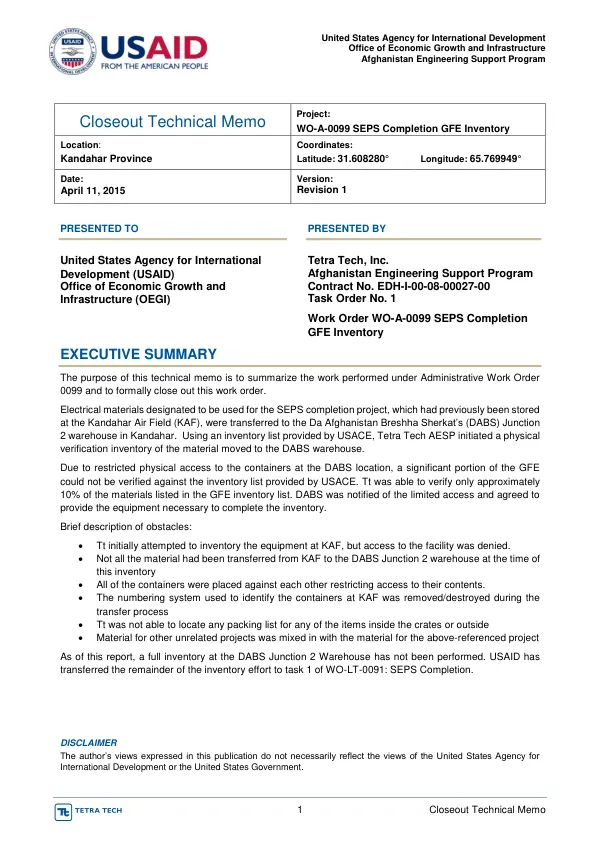 2015
2015USAID DEC
Closeout Technical Memo: SEPS Completion GFE Inventory
Open record