AGA KHAN FOUNDATION
2013 CSO Sustainability Index for Afghanistan
The Islamic Republic of Afghanistan has undergone decades of war and civil unrest.
2013 · 28 pages
Sign in to readA free account is required to download.
Abstract
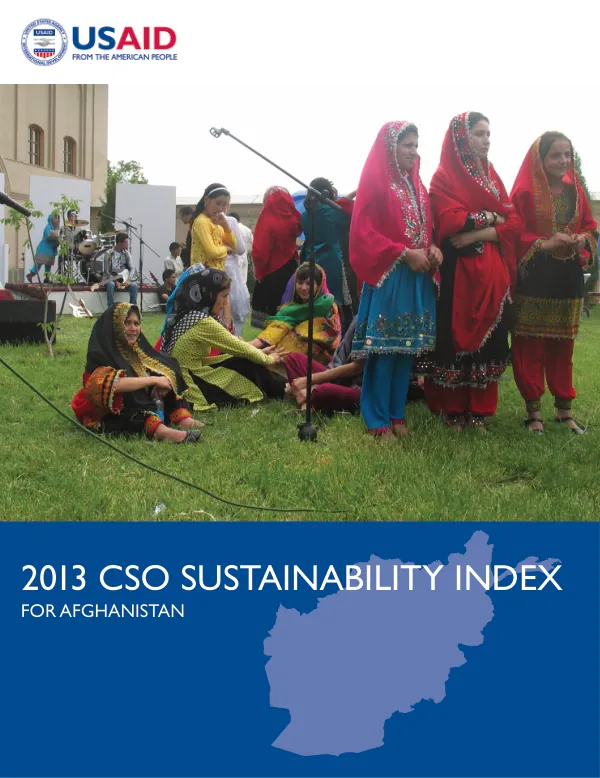
In 2013, the country continued to endure protracted internal armed conflict, insurgency, and political instability. Despite these challenges, Afghanistan made important strides in the social, economic, and political spheres in 2013. The Government of the Islamic Republic of Afghanistan presented a roadmap to achieve economic self-reliance by 2024 through twenty-two National Priority Programs (NPPs). The Afghan government and the international community established commitments under the Tokyo Mutual Accountability Framework (TMAF). The 2013 Senior Officials' Meeting (SOM) acknowledged the government's progress in realizing its commitments, including developing action plans and timelines, enacting laws needed to hold credible elections in 2014, promoting human rights and gender equality, tackling corruption, and improving financial transparency. However, there was some international concern regarding the government's level of progress, leading some donors to cut or withhold funding. Afghanistan has a complex civil society sector, with over 1,911 domestic and 287 foreign NGOs registered with the Ministry of Economy (MoE), and over 4,000 associations registered with the Ministry of Justice (MoJ). More than two-thirds of CSOs are registered in Kabul. There are also thousands of unregistered CSOs working in Afghanistan, including more than 20,000 community development councils established under the National Solidarity Program (NSP). Traditional civil society plays a significant role in Afghanistan, with over 150,000 villages having shuras (community-based councils) and jirgas (tribal assemblies of elders). CSOs in Afghanistan operate in nearly all sectors, providing basic services such as housing, education, and health, as well as more complicated interventions related to economic development, women's empowerment, and the environment. CSOs are becoming more professional and more engaged in designing programs that address community needs and priorities. They have also established a number of intermediary support organizations (ISOs), local and regional networks, coalitions, coordinating bodies, and umbrella organizations, which help develop and consolidate the sector. The legal environment in Afghanistan improved slightly in 2013 with the passage of the Law on Associations, which replaces the 2002 Law on Social Organizations and allows associations to access foreign funding and conduct advocacy. The NGO registration process is well-designed, but there are still some issues with its implementation. Domestic and foreign NGOs must undergo a two-tiered registration process involving the MoE Technical Commission and the High Evaluation Commission. For foreign NGOs, the Ministry of Foreign Affairs is also involved in the registration process. The CSO Sustainability Index for Afghanistan in 2013 scored 5.0 out of 7.0, indicating a moderate level of sustainability. The index assesses seven interrelated dimensions of CSO sustainability: legal environment, organizational capacity, financial viability, advocacy, service provision, infrastructure, and public image. The index is based on the assessment of local civil society representatives and experts, and it provides a unique tool for understanding and measuring the sustainability of the CSO sector in Afghanistan. Afghan CSOs struggle to survive as donor contributions continue to wane. Local organizations shift their activities and focus to meet changing donor interests, and they generally only receive short-term support, which undermines their sustainability. As international forces withdraw and funding decreases in the coming years, the government is expected to seek greater control over humanitarian assistance and pressure CSOs to align their activities with government plans.
Related documents