AGA KHAN FOUNDATION
2014 CSO Sustainability Index for Afghanistan
The CSO Sustainability Index for Afghanistan in 2014 reports on the strength and overall viability of the civil society sector in Afghanistan.
2014 · 25 pages
Sign in to readA free account is required to download.
Abstract
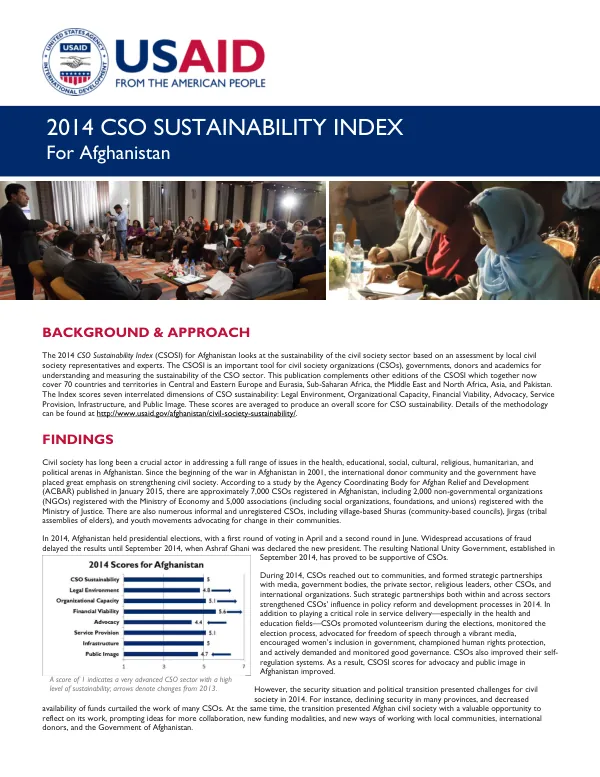
The Index is an important tool for local civil society organizations, governments, donors, academics, and others to understand and measure the sustainability of the CSO sector. The Index used the same methodology as other editions, assessing seven interrelated dimensions of CSO sustainability: legal environment, organizational capacity, financial viability, advocacy, service provision, infrastructure, and public image. The Index assigned scores to the seven dimensions on a scale of 1 to 7, with 1 representing the highest and 7 the lowest level of sustainability. The overall CSO sustainability score for Afghanistan in 2014 was 5.0. Civil society has long been a crucial actor in addressing a range of issues in Afghanistan, including health, education, social, cultural, religious, humanitarian, and political arenas. In 2014, CSOs improved their self-regulation systems, reached out to communities, and formed strategic partnerships with media, government bodies, the private sector, religious leaders, other CSOs, and international organizations. Such partnerships strengthened CSOs' influence in policy reform and development processes. CSOs also played a critical role in service delivery, promoted volunteerism during the elections, monitored the election process, advocated for freedom of speech, encouraged women's inclusion in government, championed human rights protection, and demanded good governance. However, the security situation and political transition presented challenges for civil society in 2014. Declining security in many provinces, vacant government positions, and decreased availability of funds curtailed the work of many CSOs. Despite these challenges, the transition presented Afghan civil society with a valuable opportunity to reflect on its work, prompting ideas for more collaboration, new funding modalities, and new ways of working with local communities, international donors, and the Government of Afghanistan. According to a study by the Agency Coordinating Body for Afghan Relief and Development (ACBAR), there are approximately 7,000 CSOs registered in Afghanistan, including 2,000 non-governmental organizations (NGOs) registered with the Ministry of Economy (MoEc) and 5,000 associations registered with the Ministry of Justice (MoJ). There are also numerous informal and unregistered CSOs, including village-based Shuras, Jirgas, and youth movements advocating for change in their communities. The legal environment for CSOs in Afghanistan received a score of 4.8 in 2014. The Law on Associations, adopted in 2013, allows associations to access foreign funding and conduct advocacy. However, many proposals that would benefit the sector, such as the draft Law on Foundations, a draft Law on Volunteerism, and proposed amendments to the Income Tax Law, were not adopted by the end of 2014. The Council of Ministers approved a Regulation on Procedure of Establishment and Registration of Associations in 2014, which serves as an implementing regulation and addresses several issues not originally addressed by the Law on Associations. The regulation contains both enabling and restrictive provisions, including a requirement for a minimum of ten founding members and a fixed time period within which the government must act on the registration application of an association.
Related documents