AGA KHAN FOUNDATION
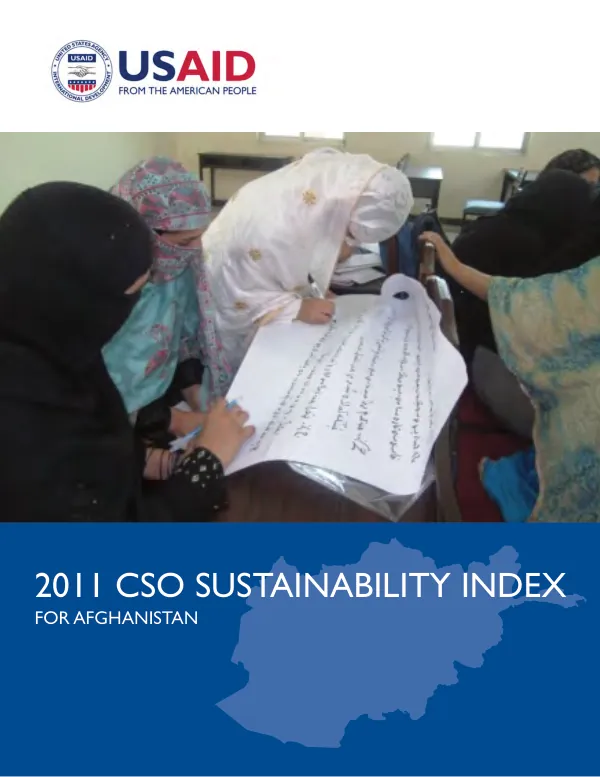
The 2011 CSO Sustainability Index for Afghanistan
Afghanistan's civil society sector operates in a challenging environment, with the country's government exerting limited control over significant portions of the territory.
2011 · 24 pages
Sign in to readA free account is required to download.
Abstract
The South and East regions continue to experience armed conflicts, and other areas are geographically isolated. Despite these difficulties, civil society plays a nascent role in the democratic process in Afghanistan. The sector's historical base consists of unregistered community-based shuras and jirgas, which are assemblies of elders. However, public understanding of the role of civil society is low, and individuals often confuse the work of civil society organizations (CSOs), the government, the private sector, and donors. The Afghan government does not view CSOs as reliable sources of information and expertise, and does not fully recognize their role as a watchdog. CSOs are still developing the necessary expertise to perform this role. Nonetheless, they regularly establish coalitions to engage in joint lobbying efforts on major issues and laws. CSOs are largely dependent on foreign funding, and local sources of support for the sector are underdeveloped. Afghanistan's legal system has undergone significant changes since 2002, with profound consequences for civil society. The Law on Social Organizations (SOs) was adopted in 2002, followed by a new constitution in 2004 that ensured greater rights and more freedom for civil society. In 2006, President Karzai signed a new Law on Non-Governmental Organizations (NGO Law), which replaced the Regulation for the Activities of National and Foreign Organizations in Afghanistan (NGO Regulation) enacted in 2001. The number of registered CSOs in Afghanistan has increased significantly since the new laws came into effect. According to official figures, there are now 1,716 NGOs and 3,004 SOs registered with the government. CSOs in Afghanistan are governed by the NGO Law and the SO Law, which require registration with the Ministry of Economy and the Ministry of Justice, respectively. The registration process is centralized and must be completed in Kabul, which is both time-consuming and costly for CSOs based in the provinces. The NGO Law stipulates that the Ministry of Economy reviews CSOs' applications within 15 days of submission. However, the complexity and slowness of the registration process may offer a temptation for corruption. The registration process for SOs has fewer administrative requirements, but requires ten founding members. Traditional shuras and jirgas are not governed by any specific written laws. The NGO Law provides a clear process and conditions for the dissolution of an NGO, including as a consequence of not providing timely reports and failures to comply with the Law. The Ministry of Economy regularly announces the dissolution of NGOs that have failed to submit activity reports for two consecutive years, following the approval of the High Evaluation Commission, National Security Administration, and civil society coordinating bodies. Since 2001, 1,715 Afghan and 301 foreign NGOs have been dissolved for not complying with the Law, including 108 NGOs in 2011. Some CSOs have expressed concern that some organizations may be dissolved for reasons other than non-compliance with the Law.