AGA KHAN FOUNDATION
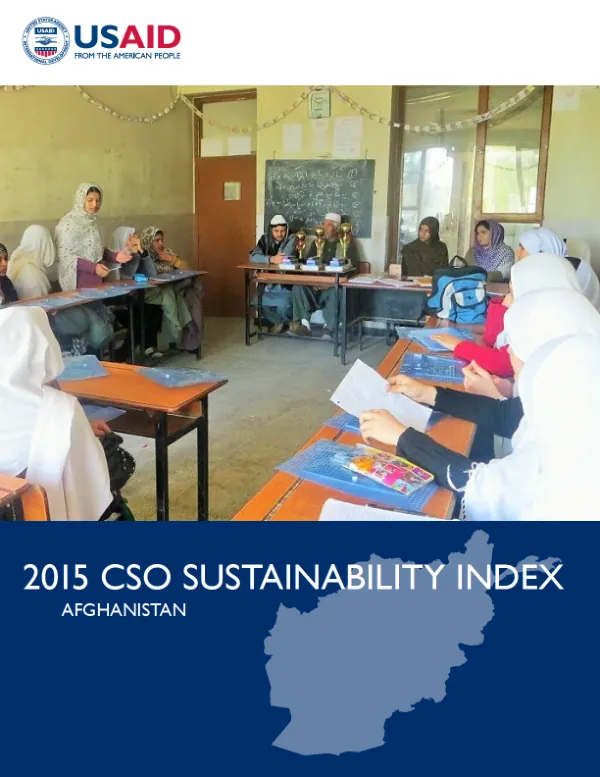
The 2015 CSO Sustainability Index for Afghanistan
The CSO Sustainability Index for Afghanistan reports on the strength and overall viability of the civil society sector in Afghanistan based on the assessment of local civil society representatives and experts.
2015 · 28 pages
Sign in to readA free account is required to download.
Abstract
The Index is an important tool for local civil society organizations, governments, donors, academics, and others to understand and measure the sustainability of the CSO sector. This publication complements similar publications covering other regions, including reports on twenty-four countries in Central and Eastern Europe and Eurasia; thirty-one countries in Sub-Saharan Africa; seven countries and territories in the Middle East and North Africa; and nine countries in Asia, including Afghanistan. The Index used the same methodology as that of other editions of the CSO Sustainability Index. A panel of local experts met to discuss progress and setbacks in seven interrelated dimensions of CSO sustainability: legal environment, organizational capacity, financial viability, advocacy, service provision, infrastructure, and public image. As part of its discussion, the panel assigned scores to the seven dimensions on a scale of 1 to 7, with 1 representing the highest and 7 the lowest level of sustainability, which were then averaged to produce an overall CSO sustainability score. Based on the expert panel's discussions as well as its own knowledge of the sector, the implementing partner drafted a narrative report that describes CSO sector sustainability, both overall and for each dimension. An Editorial Committee of technical and regional experts reviewed the country report and scores. The methodology used to determine the scores and draft the report is provided in the Annex. While CSOs still operate in a difficult environment marked by insecurity, CSO sustainability has improved over the five years that the CSO Sustainability Index for Afghanistan has been carried out. Advocacy has improved markedly over the past five years, aided by improvements in CSO coordination and collaboration with the government since the establishment of the National Unity Government (NUG) in late 2014. CSOs still struggle with limited organizational capacities, but have made progress in this area as donors have started forming more long-term partnerships with CSOs in the provinces and providing resources for institutional development. Scores for Infrastructure and Public Image have also improved somewhat: CSOs have formed new networks and thematic groups, while CSOs' involvement in the 2014 elections, particularly their civic education initiatives and mobilization of voters, increased public appreciation of the role of CSOs as well as media coverage. Other dimensions of sustainability—Legal Environment, Financial Viability, and Service Provision—have remained largely the same over the past five years. Afghanistan has two main types of CSOs: associations, governed by the 2013 Law on Associations; and NGOs, governed by the 2005 Law on NGOs. The Law on Associations provides for several categories of organizations, all of which are defined as non-profit, non-political entities voluntarily established by a group of real or legal persons in accordance with the law. At least ten founders, all of whom must be Afghan citizens, are required to establish an association. In 2015, the Supreme Court affirmed that foundations also should register with the Ministry of Justice under the Law on Associations, provided that they have at least ten founding members. The Law on NGOs provides a broad definition of an NGO: a domestic or foreign non-governmental, non-political, and not-for-profit organization. A founder of an NGO can be a natural or legal person, and either domestic or foreign. At least two founders are required to establish an NGO, one of whom must have a residence and exact address in Afghanistan. The Law on NGOs lacks clear guidance on the registration of networks. While the law does address registration of coordinations, it does not provide clear guidance on the registration of networks. In 2015, 5,789 associations, including social organizations, foundations, and unions, were registered with the Ministry of Justice, and 2,060 NGOs were registered with the Ministry of Economy, slight increases since 2014. There are also numerous informal and unregistered CSOs, including village-based Shuras, Jirgas, and youth movements advocating for change in their communities.