ICF
2013 Nigeria Demographic and Health Survey (NDHS)
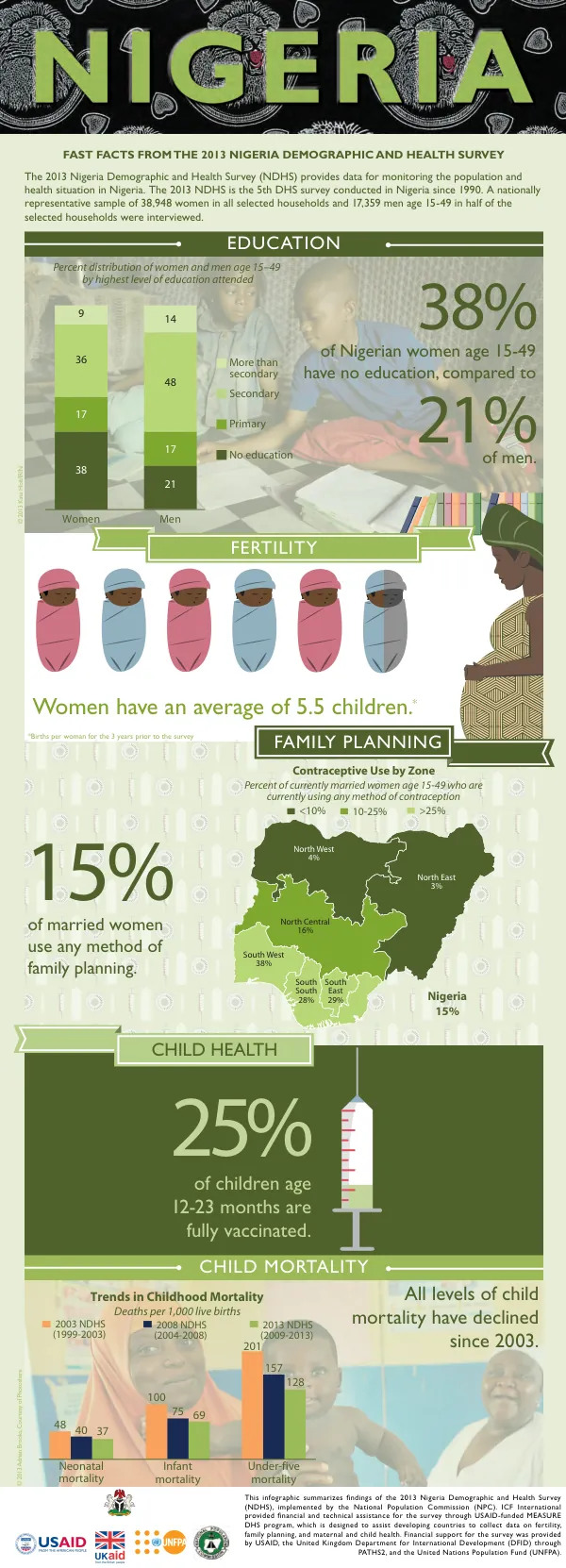
The 2013 Nigeria Demographic and Health Survey (NDHS) provides data for monitoring the population and health situation in Nigeria.
2013 · 1 pages
Sign in to readA free account is required to download.
Abstract
The survey is the 5th DHS conducted in Nigeria since 1990. A nationally representative sample of 38,948 women in all selected households and 17,359 men age 15-49 in half of the selected households were interviewed. The survey reveals that 38% of Nigerian women age 15-49 have no education, compared to 21% of men. Women have an average of 5.5 children, with births per woman for the 3 years prior to the survey averaging 5.5. The use of family planning methods is limited, with 15% of married women currently using any method of contraception. Contraceptive use varies significantly by zone, ranging from 3% in the North East to 38% in the South West. Child health indicators have improved since 2003, with all levels of child mortality declining. Infant mortality rates have decreased from 75 deaths per 1,000 live births in 2003 to 69 deaths per 1,000 live births in 2008 and 157 deaths per 1,000 live births in 2013. Under-five mortality rates have also declined, from 128 deaths per 1,000 live births in 2003 to 100 deaths per 1,000 live births in 2008 and 201 deaths per 1,000 live births in 2013. Neonatal mortality rates have decreased from 40 deaths per 1,000 live births in 2003 to 37 deaths per 1,000 live births in 2008 and 48 deaths per 1,000 live births in 2013. The survey was implemented by the National Population Commission (NPC) with financial and technical assistance from ICF International through the USAID-funded MEASURE DHS program. Financial support was also provided by USAID, the United Kingdom Department for International Development (DFID) through PATHS2, and the United Nations Population Fund (UNFPA). The survey's findings provide valuable insights into the population and health situation in Nigeria, highlighting areas for improvement and informing policy and program development. The survey's data on education, fertility, family planning, and child health are critical for understanding the health and well-being of Nigerian women and children. The findings have significant implications for the development of effective health programs and policies, particularly in areas with limited access to education and healthcare services.
Related documents
![Community Improved Sanitation Coverage and Childhood Stunting (SAR23) - Analysis Brief [AB31]](https://covers.devme.ai/gen/146599.webp)