EUROPEAN UNION
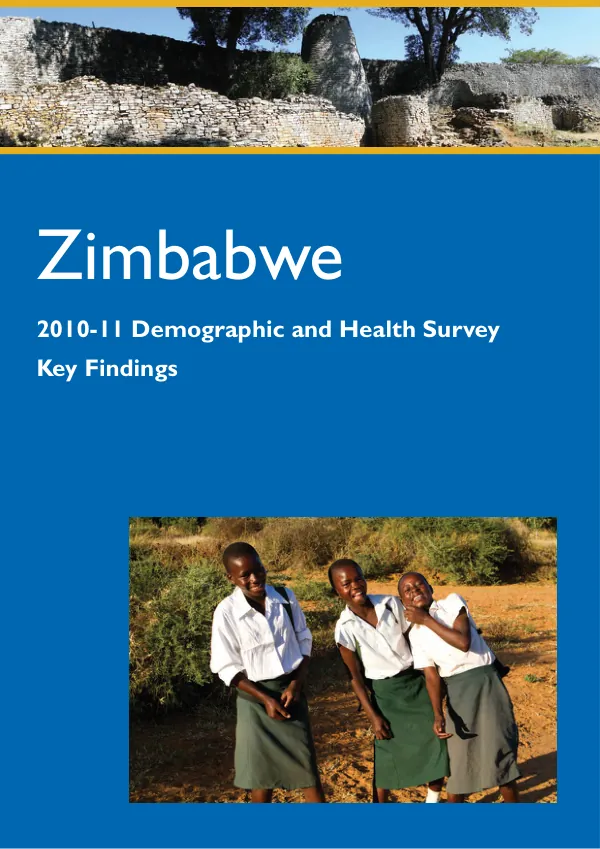
2010-11 Zimbabwe Demographic and Health Survey
The 2010-11 Zimbabwe Demographic and Health Survey (ZDHS) was implemented by the Zimbabwe National Statistics Agency (ZIMSTAT) with funding from various international organizations, including the United States Agency for International Development (USAID), the Centers for Disease Control and Prevention (CDC), and the United Nations Population Fund (UNFPA).
2012 · 20 pages
Sign in to readA free account is required to download.
Abstract
The survey aimed to provide data on the population and health situation in Zimbabwe, focusing on fertility, family planning, childhood mortality, nutrition, maternal and child health, domestic violence, malaria, maternal mortality, awareness and behavior regarding HIV/AIDS and other sexually transmitted infections (STIs), and HIV prevalence. A nationally representative sample of 9,171 women age 15-49 and 7,480 men age 15-54 were interviewed, representing a response rate of 93% for women and 86% for men. The sample provides estimates at the national, urban-rural, and provincial levels. The survey found that Zimbabwean households consist of an average of 4.1 people, with 43% of household members being children under age 15. Approximately one-fifth of children under age 18 are orphaned, meaning one or both parents are dead. Housing conditions vary greatly based on residence, with 83% of urban households having electricity compared to 13% of rural households. Access to improved water sources also differs, with 95% of urban households having access compared to 70% of rural households. The survey found that 38% of Zimbabwean households own a radio, 62% have a mobile phone, and 74% of urban households have a television. Rural households are more likely to own agricultural land, while urban households are more likely to have a bank account. The survey also collected data on education, with more than 70% of women and men having attended at least some secondary school. Six percent of women and 11% of men have completed secondary school or beyond. Urban residents and those living in Bulawayo and Harare are more likely to have attended at least some secondary school, completed secondary school, or gone beyond secondary school. Overall, 94% of women and 96% of men are literate. The survey found that women in Zimbabwe have an average of 4.1 children, a slight increase since the 2005-06 ZDHS. Fertility varies by residence and province, with women in urban areas having 3.1 children on average compared to 4.8 children per woman in rural areas. Fertility is lowest in Bulawayo (2.8) and highest in Manicaland (4.8). Fertility also varies with mother's education and economic status, with women with no education having two more children than women with higher education (4.5 versus 2.5 children per woman). Teenage fertility is a concern, with 24% of young women age 15-19 having already begun childbearing. Young motherhood is more common in rural areas than in urban areas, and young women in the poorest households are nearly four times as likely to have started childbearing by age 19 as those in the wealthiest households (36% versus 10%). The survey also found that 38% of women age 25-49 and 20% of men age 25-49 were sexually active by the age of 18, with 6% of women and 2% of men having had sex by the age of 15. The survey found that 11% of women are married to a man with more than one wife, with polygamy being most common in Manicaland and Mashonaland Central and among women with no education. Desired family size varies by residence, province, and wealth, with women with more than secondary education desiring fewer children than women with no education (3.2 versus 5.6). Knowledge of family planning methods is nearly universal, with 98% of women and 99% of men age 15-49 knowing at least one modern method of family planning. The most commonly known methods are male condoms, injectables, and the pill. Current use of family planning is high, with nearly 6 in 10 married women (57%) currently using a modern method of family planning. The pill (41%) and injectables (8%) are the most commonly used methods. Use of modern family planning methods varies by province, with a low of 45% in Matabeleland South and a high of 62% in Mashonaland Central. Modern contraceptive use increases with education and wealth, with 67% of married women with more than secondary education using modern methods compared to 42% of married women with no education.
Related documents