ICF
Female Genital Mutilation/Cutting (FGM/C) in The Gambia
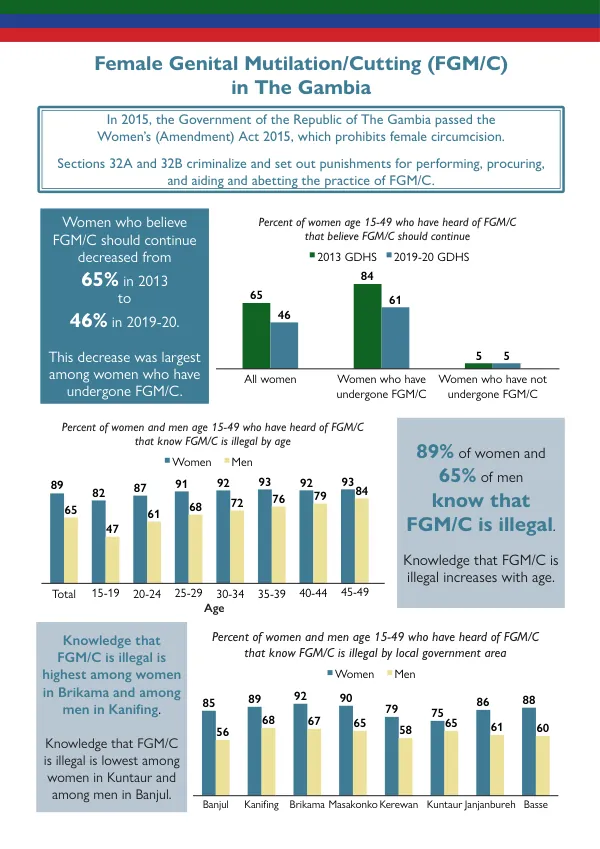
The Women's (Amendment) Act 2015 in The Gambia prohibits female circumcision, with sections 32A and 32B criminalizing and setting out punishments for performing, procuring, and aiding and abetting the practice.
2023 · 4 pages
Sign in to readA free account is required to download.
Abstract
The act aims to eliminate Female Genital Mutilation/Cutting (FGM/C), a practice that has been prevalent in the country. Knowledge about the illegality of FGM/C varies across different regions in The Gambia. Women in Brikama and men in Kanifing have the highest knowledge about the illegality of FGM/C, while women in Kuntaur and men in Banjul have the lowest knowledge. According to the 2019-20 Gambia Demographic and Health Survey (GDHS), 89% of women and 65% of men know that FGM/C is illegal. The prevalence of FGM/C among girls in The Gambia is high, with nearly 5 in 10 girls aged 0-14 having undergone the practice. The majority of girls were cut before the age of 5, with 4 in 10 girls being cut before the age of 5. The prevalence of FGM/C ranges from 25% in Banjul to 79% in Basse. Despite increased awareness and changing attitudes, FGM/C continues to be practiced in The Gambia. More than 6 in 10 women who have undergone FGM/C were cut before the age of 5. The prevalence of FGM/C is slightly higher in urban areas than in rural areas, but there is no clear relationship between FGM/C and women's education. The prevalence of FGM/C among women in The Gambia is nearly three times higher than in neighboring Senegal. The 2019-20 GDHS was implemented by the Gambia Bureau of Statistics (GBoS) with funding from various international organizations, including the United States Agency for International Development (USAID), the United Nations Population Fund (UNFPA), and the World Health Organization (WHO). The survey found that only Mali has a higher prevalence of FGM/C among girls than The Gambia.
Related documents