USAID
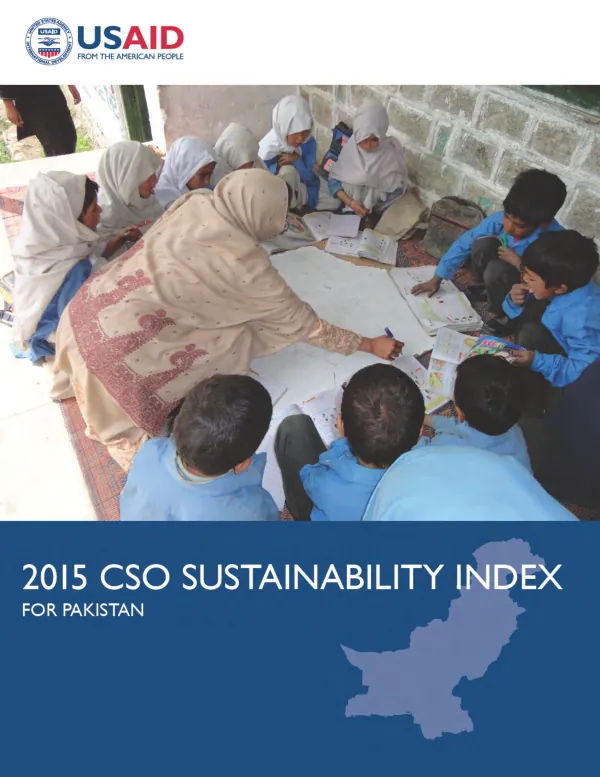
2015 CSO Sustainability Index for Pakistan
The CSO Sustainability Index for Pakistan assesses the sustainability of the civil society sector based on an assessment by local civil society representatives and experts.
2016 · 1 pages
Sign in to readA free account is required to download.
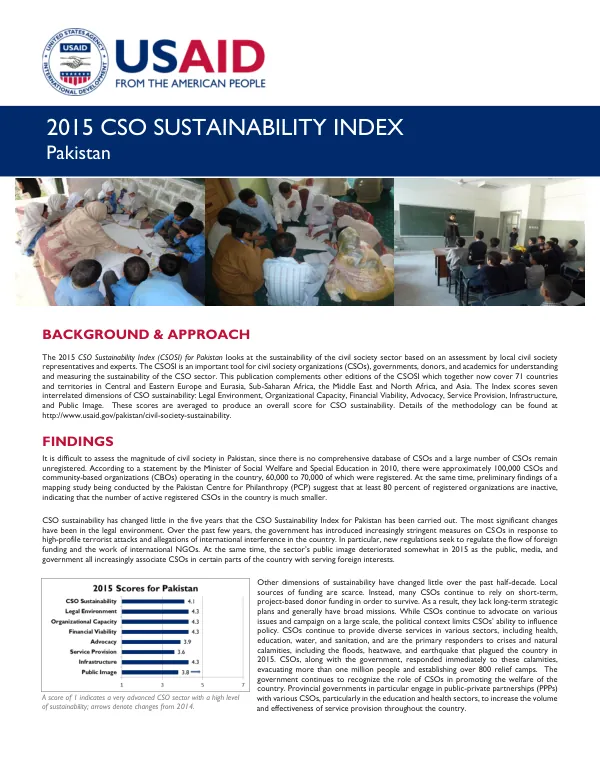
Abstract
The Index scores seven interrelated dimensions of CSO sustainability: Legal Environment, Organizational Capacity, Financial Viability, Advocacy, Service Provision, Infrastructure, and Public Image. These scores are averaged to produce an overall score for CSO sustainability. The assessment of civil society in Pakistan is challenging due to the lack of a comprehensive database of civil society organizations (CSOs) and community-based organizations (CBOs). According to the Minister of Social Welfare and Special Education, there were approximately 100,000 CSOs and CBOs operating in the country in 2010, with 60,000 to 70,000 registered. However, a mapping study conducted by the Pakistan Centre for Philanthropy suggests that at least 80 percent of registered organizations are inactive, indicating a much smaller number of active registered CSOs. CSO sustainability in Pakistan has changed little over the past five years. The most significant changes have been in the legal environment, with the government introducing increasingly stringent measures on CSOs in response to high-profile terrorist attacks and allegations of international interference. New regulations aim to regulate the flow of foreign funding and the work of international NGOs. The sector's public image has also deteriorated somewhat in 2015, with the public, media, and government increasingly associating CSOs with serving foreign interests. Other dimensions of sustainability have remained relatively stable. Local sources of funding are scarce, and many CSOs continue to rely on short-term, project-based donor funding to survive. This lack of long-term strategic planning and broad missions hinders the sector's ability to effectively advocate for policy changes. Despite these challenges, CSOs continue to provide diverse services in various sectors, including health, education, water, and sanitation, and are the primary responders to crises and natural calamities. Provincial governments engage in public-private partnerships with CSOs to increase the volume and effectiveness of service provision. The 2015 CSO Sustainability Index for Pakistan highlights the need for the sector to adapt to changing circumstances and improve its sustainability. The Index scores indicate that the sector faces significant challenges, particularly in the legal environment and public image. However, the sector's ability to provide essential services and respond to crises demonstrates its resilience and importance in promoting the welfare of the country.