ABT ASSOCIATES
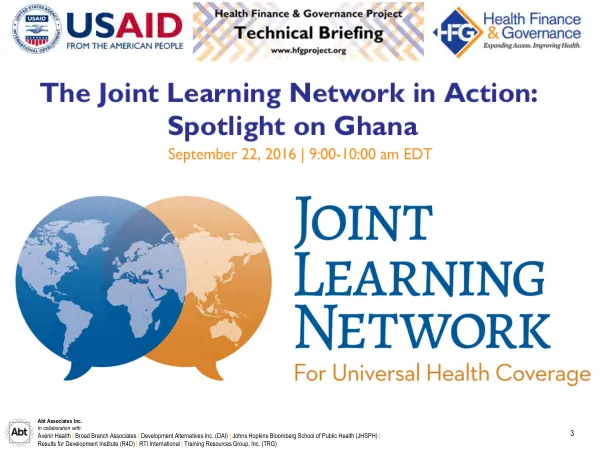
Joint Learning Network for Universal Health Coverage: Session Outline
The Joint Learning Network (JLN) is a collaborative effort aimed at extending quality health services to more than 3 billion people and ensuring financial protection.
2016 · 18 pages
Sign in to readA free account is required to download.
Abstract
The network's end goal is to achieve universal health coverage (UHC) by expanding health service coverage to reach target populations, increasing access to essential health services, improving the quality of care and patient safety, and promoting financial sustainability. The JLN has expanded its membership to 27 countries, with Ghana, Indonesia, India, Kenya, the Philippines, Malaysia, Mali, Nigeria, and Vietnam serving as full members. Associate countries include Bangladesh, Bahrain, Colombia, Egypt, Ethiopia, Japan, Kosovo, Liberia, Mexico, Moldova, Mongolia, Morocco, Namibia, Peru, Senegal, South Korea, Sudan, and Yemen. The JLN's goals are supported by cross-cutting functions, which include costing and pricing of services, utilization review/quality audits, targeting – policy and design of mechanisms, delivery system/provider network design, licensing/accreditation, provider payment, information technology, strategic communication, benefits design/health technology assessment, monitoring progress/M&E, human resources, and institutional roles & governance. The JLN has prioritized several technical goals, including primary health care (PHC) self-assessment, engaging the private sector in PHC delivery, health benefits policies for PHC, PHC performance measurement and improvement, and financing and payment models for PHC. The network has also established several technical initiatives and collaboratives, such as the PHC-UHC Self-Assessment, Engaging the Private Sector in PHC Delivery, and Health Benefits Policies for PHC. The JLN's approach to achieving UHC is based on a collaborative learning model, which involves identifying common problems, collective problem-solving, synthesizing new knowledge, adapting knowledge within JLN countries, and disseminating knowledge to other countries. This approach has several key benefits, including strong country ownership, relevance to country priorities, space to analyze root causes, building trust and a safe space for collaboration, and creating opportunities for responsive follow-up by partners. Examples of co-produced knowledge and tools developed by the JLN include the Primary Healthcare Self-Assessment Tool, Health Data Dictionary, Costing Manual, and Toolkit. These resources are designed to support countries in achieving UHC by providing practical guidance on the "how-to's" of implementing UHC policies and programs.
Related documents