GLOBAL FUND
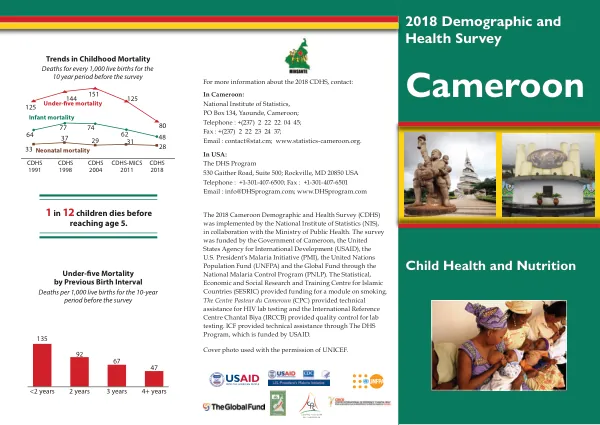
2018 Cameroon Demographic and Health Survey: Child Health and Nutrition
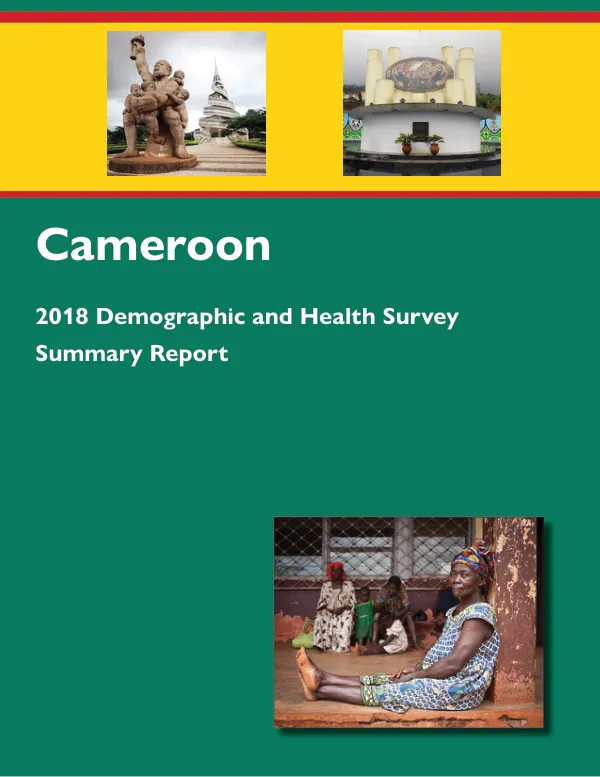
The 2018 Cameroon Demographic and Health Survey (CDHS) was implemented by the National Institute of Statistics (NIS) in collaboration with the Ministry of Public Health.
2018 · 2 pages
Sign in to readA free account is required to download.
Abstract
The survey was funded by the Government of Cameroon, the United States Agency for International Development (USAID), the U.S. President's Malaria Initiative (PMI), the United Nations Population Fund (UNFPA), and the Global Fund through the National Malaria Control Program (PNLP). The Statistical, Economic and Social Research and Training Centre for Islamic Countries (SESRIC) provided funding for a module on smoking, while the Centre Pasteur du Cameroun (CPC) and the International Reference Centre Chantal Biya (IRCCB) provided technical assistance for HIV lab testing and quality control for lab testing, respectively. ICF provided technical assistance through The DHS Program, which is funded by USAID. The survey collected data from over 13,000 women aged 15-49, who provided information on the health and nutritional status of their children. The data revealed that 29% of children under 5 are stunted, or too short for their age. Trends in vaccination coverage showed that 40% of children 12-23 months received all basic vaccinations in 1991, increasing to 52% in 2018. The percentage of children under 5 who are stunted, underweight, or wasted also showed a decline over the years, from 33% in 1991 to 6% in 2018. Breastfeeding status among children under 6 months showed that 40% were exclusively breastfed, while 29% were breastfed and given water. The percentage of children 12-23 months who received the BCG, DTCoq-HepB-Hib, Polio, and Measles vaccinations also showed an increase over the years, from 87% in 1991 to 86% in 2018 for the BCG vaccination. Anemia among children 6-59 months was found to be prevalent, with 2% suffering from severe anemia, 26% from mild anemia, and 29% from moderate anemia. Vaccination coverage varied by region, with the highest percentage of children 12-23 months receiving all basic vaccinations found in Douala (74%) and Yaounde (62%). The lowest percentage was found in the Far-North region (39%). The data also showed that anemia among children was more prevalent in the South-West region (52%), while the North-West region had the highest percentage of children receiving all basic vaccinations (68%).
![Community Improved Sanitation Coverage and Childhood Stunting (SAR23) - Analysis Brief [AB31]](https://covers.devme.ai/gen/146599.webp)