GLOBAL FUND
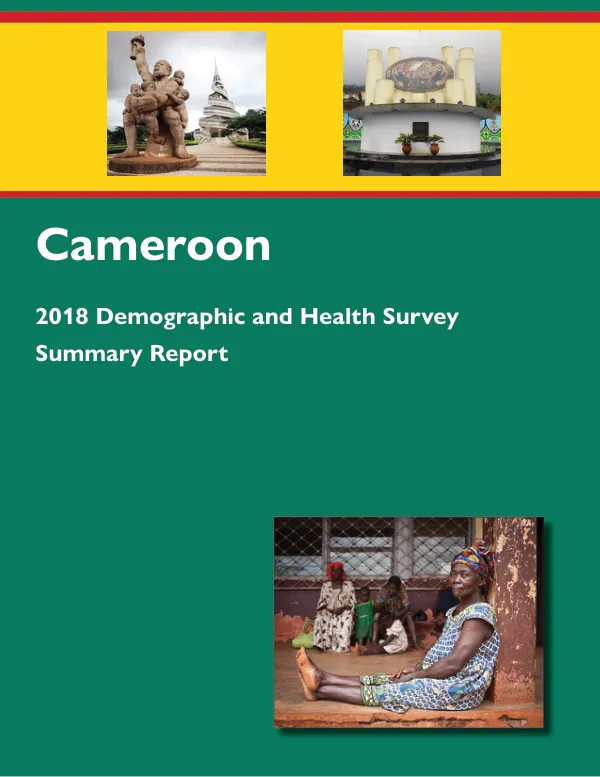
2018 Cameroon Demographic and Health Survey - Summary Report
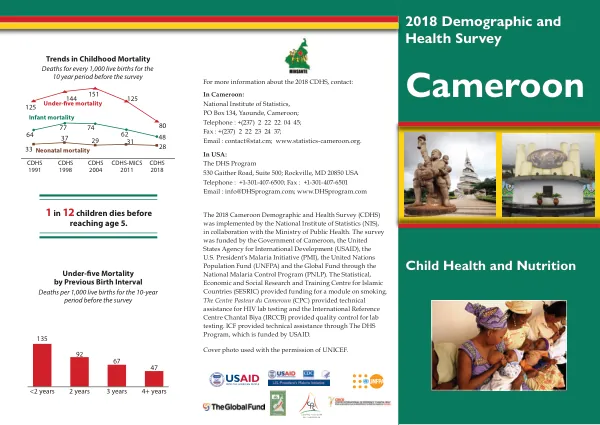
The 2018 Cameroon Demographic and Health Survey (CDHS) was implemented by the National Institute of Statistics (NIS) in collaboration with the Ministry of Public Health.
2020 · 20 pages
Sign in to readA free account is required to download.
Abstract
The survey was funded by the Government of Cameroon, the United States Agency for International Development (USAID), the U.S. President’s Malaria Initiative (PMI), the United Nations Population Fund (UNFPA), and the Global Fund through the National Malaria Control Program (PNLP). The Statistical, Economic and Social Research and Training Centre for Islamic Countries (SESRIC) provided funding for a module on smoking, while the Centre Pasteur du Cameroun (CPC) and the International Reference Centre Chantal Biya (IRCCB) provided technical assistance for HIV lab testing and quality control, respectively. ICF provided technical assistance through The DHS Program, which is funded by USAID. A nationally representative sample of 13,527 women age 15-49 in all selected households and 6,978 men age 15-64 in half of the selected households were interviewed. This represents a response rate of 98% of women and 98% of men. The sample design for the 2018 CDHS provides estimates at the national level, for urban and rural areas, and for 12 study domains. Due to security concerns, teams were not permitted to visit some zones in South-West, and the data presented for that region are not representative of the region as a whole but reflect the situation in urban areas. Cameroon households have an average of 5 members, with one-quarter (26%) of households headed by a woman. Almost half (45%) of the household population is under age 15. In terms of electricity, water, and sanitation, just over 60% of households in Cameroon have electricity, with 90% of households in urban areas having electricity compared to only 27% in rural areas. Almost 4 in 5 (79%) households have an improved water source, with 96% of households in urban areas having improved water compared to 57% in rural areas. Nationally, 3 in 5 households have an improved sanitation facility, with 5% of households using open defecation. The large majority (85%) of households in Cameroon own a mobile phone, while fewer own a television (51%) or a radio (39%). Only 7% of households own a car or truck, and 21% own a motorcycle or motorbike. More than half of households (56%) own agricultural land, with this being much more common in rural than urban areas (86% versus 32%). Rural households are also more likely to own farm animals (63% versus 16%). Twenty percent of women and 10% of men age 15-49 in Cameroon have received no education. The majority have gone to at least some primary or secondary school, with only 8% of women and 11% of men having gone beyond secondary school. Seventy percent of women and 83% of men age 15-49 are literate, with only half of women in rural areas being literate compared to 86% in urban areas. Women in Cameroon have an average of 4.8 children, with the Total Fertility Rate (TFR) having declined slightly from 5.1 in 2011. Fertility is highest in rural areas, where women have an average of 6.0 children compared to 3.8 children per woman in urban areas. Fertility decreases with women’s education, with women with no education having twice as many children, on average, as women with higher than secondary education (TFR of 6.2 and 3.0, respectively). Fertility also decreases with household wealth, with women living in the poorest households having an average of 6.6 children, while women in the wealthiest households have an average of 3.0 children. Among women and men age 25-49, 57% of women and 42% of men are currently married or living together, with one-third of women and more than half of men (55%) being single. Women and men in Cameroon initiate sexual activity at relatively young ages, with women having their first sexual intercourse at a median age of 17.0 and men initiating sexual activity at a median age of 19.3. Eighteen percent of women and 7% of men age 25-49 began sexual activity by age 15, with women with higher than secondary education initiating sexual activity more than 3 years later than women with no education (median age of 19.4 versus 16.0). More than one-third of women age 25-49 are married by age 18 compared to less than 5% of men in the same age group, with women marrying at a median age of 20.0 and men marrying much later, at a median age of 27.5. Among women, median age at first marriage increases substantially with education and household wealth, with women