USAID DEC
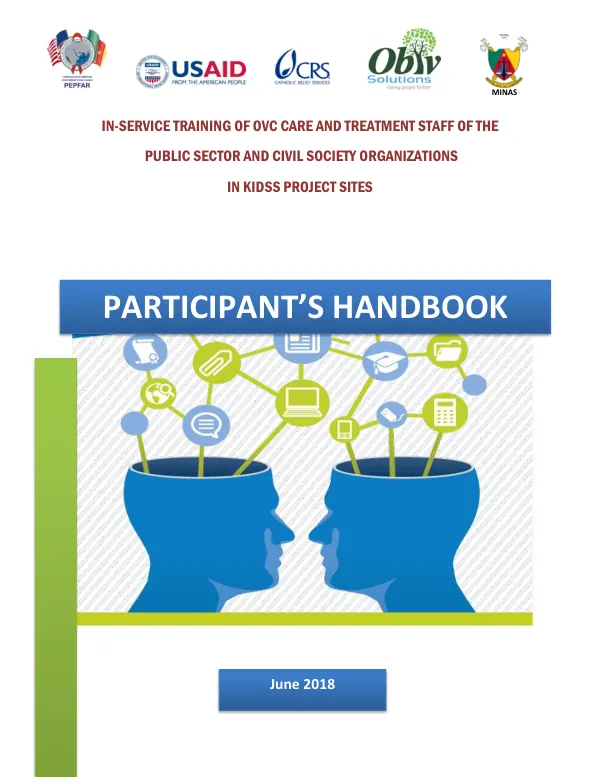
In-Service Training of OVC Care and Treatment Staff of the Public Sector and Civil Society Organizations in KIDSS Project Sites
Sign inUNICEF
In-Service Training of OVC Care and Treatment Staff of the Public Sector and Civil Society Organizations in KIDSS Project Sites
The in-service training for OVC care and treatment staff of the public sector and civil society organizations in KIDSS project sites aims to build the capacity of caregivers in the nutritional care of orphans and other vulnerable children.
2018 · 120 pages
Sign in to readA free account is required to download.
Abstract
The training is a response to the significant quantitative and qualitative deficits in the staff responsible for the care and treatment of OVC and their households in KIDSS project sites. A study conducted by the OBIV solution consultancy firm in 2017 found a deficit of 1965 social workers compared to the needs of the target population, with only 18.7% of staff providing services to OVC being trained social workers. The training focuses on building the capacity of social workers to provide nutritional care to OVC, with a specific emphasis on the nutritional needs of children infected with HIV. According to UNICEF, children with HIV have specific health and nutrition needs, and a link between nutrition and HIV has been established. Children living with HIV/AIDS are at high risk of malnutrition, and inadequate care can lead to a weakening of the immune system, increased susceptibility to infections, and growth retardation. The training includes a module on general food concepts, which covers the definition of food, digestion, and nutrients. The concept of a balanced diet is also discussed, with the idea that a meal should consist of at least one food from each of the three major groups: energy providers, builders, and protectors. The training also emphasizes the importance of a balanced diet for children infected with HIV, who require adequate nutrition to grow and fight infection. The training also includes a module on assessing the nutritional status of children in the community, which involves evaluating anthropometric measurements, medical history, clinical and biometric parameters, dietetic practice, ongoing treatment, and food security situation. Optimal nutritional status is a factor of health promotion, prevention, and treatment of diseases, and loss of weight can lead to undernutrition and even death. The training aims to equip social workers with the knowledge and skills to provide nutritional care to OVC, with a focus on the specific needs of children infected with HIV. The training is a critical component of the KIDSS project, which aims to improve the health and well-being of OVC in the community. The training is designed to be practical and effective, with a focus on building the capacity of social workers to provide nutritional care to OVC. The training includes a range of topics, from general food concepts to assessing the nutritional status of children in the community. The training is a critical component of the KIDSS project, which aims to improve the health and well-being of OVC in the community. The training is expected to result in the appropriation of the PEC NUTRITIONAL process by each participant, with a focus on building the capacity of social workers to provide nutritional care to OVC. The training is a critical component of the KIDSS project, which aims to improve the health and well-being of OVC in the community. The training is designed to be a beginning of a solution to fill the quantitative and qualitative gap in the staff responsible for the care and treatment of OVC and their households in KIDSS project sites. The training is a critical component of the KIDSS project, which aims to improve the health and well-being of OVC in the community.