GOVERNMENT OF KENYA
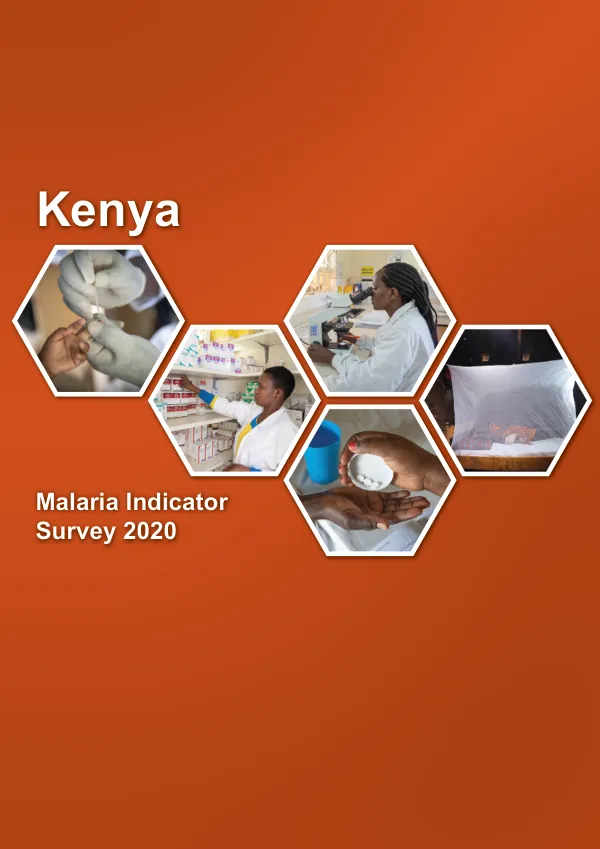
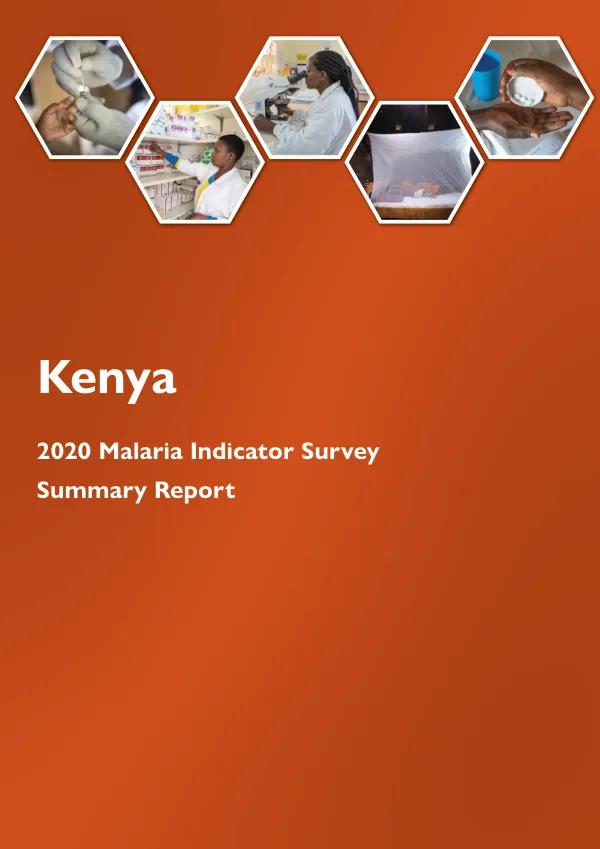
2020 Kenya Malaria Indicator Survey Summary Report
The 2020 Kenya Malaria Indicator Survey (KMIS) was implemented by the Ministry of Health (MOH) Division of National Malaria Programme (DNMP) and the Kenya National Bureau of Statistics (KNBS).
2021 · 12 pages
Sign in to readA free account is required to download.
Abstract
Financial support for the survey was provided by the United States Agency for International Development (USAID) through the President's Malaria Initiative (PMI) and by the Government of Kenya with Global Fund support. ICF provided technical assistance through The DHS Program, a USAID-funded project offering support and technical assistance in the implementation of population and health surveys in countries worldwide. The survey's objective is to provide reliable estimates that can be used by programme managers and policymakers to evaluate and improve existing programs, including mosquito net ownership, access, and use; coverage of intermittent preventive treatment of malaria in pregnancy; case management of fever and malaria in children; knowledge, attitudes, and practices regarding malaria control; and the prevalence of Plasmodium species most prevalent in Kenya. The 2020 KMIS fieldwork was originally planned from June to July 2020, but due to the COVID-19 pandemic, the survey's stakeholders agreed on an adjusted plan to hold fieldwork in October-December 2020, which coincided with the short rains, and to pivot to a virtual technical assistance model for training and survey oversight. A nationally representative sample of 6,771 women in 7,952 households were interviewed, representing a response rate of 96% of women and 97% of households. The sample design for the 2020 KMIS provides estimates at the national level, for urban and rural areas, and for 5 malaria endemicity zones — Highland epidemic prone, Lake endemic, Coast endemic, Seasonal, and Low risk. The average household size in Kenya is 3.7 members, with nearly 1 in 3 households headed by women (31%). Thirty-nine percent of the Kenyan population is under age 15. Households in Kenya have varying levels of access to basic necessities. Seven in ten Kenyan households have access to an improved source of drinking water, with 92% of urban households and 56% of rural households having access to an improved source of drinking water. Two-thirds of households in Kenya use an improved sanitation facility, including facilities shared with other households. Urban households are more likely than rural households to use improved sanitation facilities (79% versus 58%). More than half of Kenyan households have electricity (55%), with the majority of urban households having electricity (84%), compared to 37% of rural households. The survey also collected data on household ownership of goods, including mobile phones, radios, televisions, agricultural land, and farm animals. Most Kenyan households have a mobile phone (90%), with 72% having a radio and 49% having a television. More than half of Kenyan households own agricultural land (52%) or farm animals (56%). Urban households are more likely than rural households to own a mobile telephone, radio, or television, while rural households are more likely to own agricultural land or farm animals than urban households. The survey found that 49% of households in Kenya own at least one insecticide-treated net (ITN) or ITN. However, only 29% of households have enough ITNs to cover each household member, assuming one ITN is used by two people. One in five households have at least one ITN but not enough for all household members, while half of households do not have an ITN. Access to an ITN is a calculation of the proportion of the population that could sleep under an ITN if each ITN in the household were used by up to two people. Forty percent of the household population in Kenya has access to an ITN, and 35% of the population slept under an ITN the night before the survey. Malaria in pregnancy contributes to low birth weight, infant mortality, and other complications. To prevent malaria, pregnant women living in malaria-endemic areas in Kenya should receive 3+ doses of SP/Fansidar during their pregnancy. In Kenya, 38% of pregnant women received at least 1 dose of this intermittent preventive treatment, or IPTp, while 30% of women received 2+ doses and only 22% received 3+ doses. Uptake of IPTp 1+ and IPTp 2+ have declined since 2015, while uptake of IPTp 3+ has stagnated. The Kenya National Malaria Strategy targets IPTp interventions to women living in malaria-endemic areas. Among pregnant women living in IPTp targeted malaria endemic areas, 49% in Lake endemic zone and 46% in Coast endemic zone received 3+ doses of IPTp.