ICF
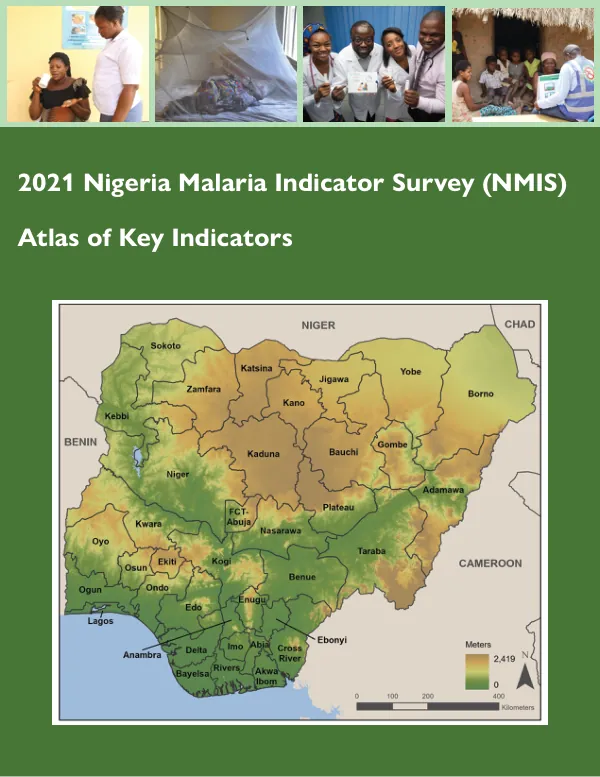
2021 Nigeria Malaria Indicator Survey: Atlas of Key Indicators
The 2021 Nigeria Malaria Indicator Survey (NMIS) was implemented by the National Malaria Elimination Programme (NMEP) of the Federal Ministry of Health, Nigeria, in collaboration with the National Population Commission (NPC).
2023 · 24 pages
Sign in to readA free account is required to download.
Abstract
The funding for the 2021 NMIS was provided by the United States Agency for International Development (USAID) and The Global Fund. ICF provided technical assistance through The DHS Program, a USAID-funded project that provides support and technical assistance in the implementation of population and health surveys in countries worldwide. A nationally representative sample of 14,476 women age 15–49 were interviewed in 13,727 selected households, representing a response rate of 99% among both women and households. Over 11,000 children under 5 were tested for malaria as part of the 2021 NMIS. This sample provides most indicators for the country as a whole, for urban and rural areas separately, and for each of the country's six geo-political zones. Some of the survey indicators are also provided for each of the 36 states and the Federal Capital Territory (FCT). The survey found that over half of households in Nigeria own at least one insecticide-treated net (ITN). However, fewer than 25% of households in Enugu and Rivers states own at least one ITN compared with 85% or more of households in Kano, Jigawa, and Adamawa states. The percent of households in Nigeria that own at least one ITN increased from 8% in 2008 to 69% in 2015 before decreasing to 56% in 2021. ITN access is defined as the proportion of the population that could sleep under an ITN if each ITN in the household were used by up to two people. Just over 40% of the population has access to an ITN. ITN access is below 20% in Ekiti, Enugu, Anambra, and Rivers states while more than 65% of the population in Gombe, Jigawa, and Adamawa states has access to an ITN. Nationally, more than one-third (36%) of Nigerians slept under an ITN the night before the survey. Young children are especially vulnerable to malaria. Nationally, more than 2 in 5 children under 5 slept under an ITN the night before the survey. Pregnant women are also particularly vulnerable to malaria and are advised to sleep under ITNs. Half of pregnant women in Nigeria slept under an ITN the night before the survey. The use of ITNs by all household members, children under 5, and pregnant women increased between 2008 and 2010 and then decreased between 2010 and 2013. ITN use dramatically increased between 2013 and 2015 and then reached peak levels of use in 2018. Use of ITNs decreased between 2018 and 2021 among household members, children under 5, and pregnant women.