USAID DEC
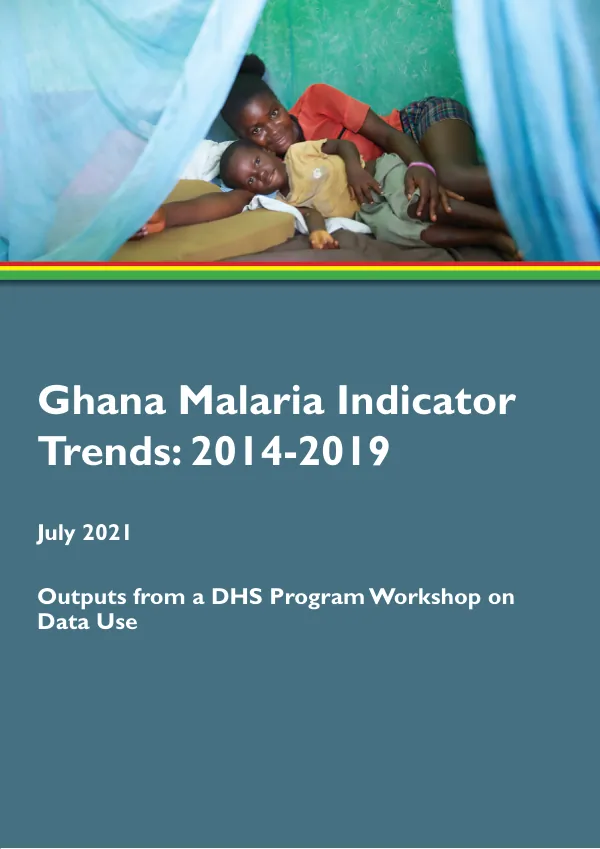
Ghana Malaria Indicator Trends: 2014-2019 - Outputs from a DHS Program Workshop on Data Use
Sign inGHANA HEALTH SERVICE
Ghana Malaria Indicator Trends: 2014-2019 - Outputs from a DHS Program Workshop on Data Use
The 2019 Ghana Malaria Indicator Survey (2019 GMIS) was implemented by the Ghana Statistical Service (GSS) in close collaboration with the Ghana National Malaria Control Programme (NMCP) and the National Public Health and Reference Laboratory (NPHRL) of the Ghana Health Service (GHS).
2021 · 64 pages
Sign in to readA free account is required to download.
Abstract
Financial support for the survey was provided by the United States Agency for International Development (USAID), The Global Fund to Fight AIDS, Tuberculosis and Malaria, and the Government of Ghana. ICF provided technical assistance through The DHS Program, a USAID-funded project offering support and technical assistance in the implementation of population and health surveys in countries worldwide. A nationally representative sample of 5,799 households and 5,181 women age 15-49 were successfully interviewed. The sample design for the 2019 Ghana MIS provides estimates for the country as a whole, for urban and rural areas separately, and for each of the 10 administrative regions as defined in the Ghana 2010 Population and Housing Census. Data were collected on ownership and use of mosquito bed nets, coverage of intermittent preventive treatment to protect pregnant women against malaria, practices and specific medications used to treat malaria, and malaria knowledge and communication messages. Blood samples for anaemia and malaria testing were collected via finger or heel pricks from children age 6-59 months whose parents or guardians consented to the specified test. The 2019 GMIS provides population-based estimates of malaria indicators to complement routine administrative data that are used to inform strategic planning and evaluation of the Ghana Malaria Control Programme. The survey is designed to provide current estimates of key malaria indicators in Ghana, including household ownership of insecticide-treated nets (ITNs), ITN access and use among the population, ITN use among vulnerable groups, intermittent preventive treatment in pregnancy, malaria case management in children, prevalence of anaemia and malaria, and more. The survey results show that in 2019, 73.7% of households had at least one insecticide-treated net (ITN), with a 95% confidence interval ranging from 72.0% to 75.5%. The use of ITNs among children under five was 64.1%, with a 95% confidence interval ranging from 61.4% to 66.8%. The prevalence of anaemia among children under five was 34.6%, with a 95% confidence interval ranging from 32.4% to 36.8%. The prevalence of malaria among children under five was 10.3%, with a 95% confidence interval ranging from 8.4% to 12.2%. The survey results also show that there were significant improvements in malaria indicators between 2016 and 2019. The percentage of households with at least one ITN increased from 64.1% in 2016 to 73.7% in 2019. The percentage of children under five who slept under an ITN increased from 54.1% in 2016 to 64.1% in 2019. The prevalence of anaemia among children under five decreased from 41.1% in 2016 to 34.6% in 2019. The prevalence of malaria among children under five decreased from 14.1% in 2016 to 10.3% in 2019. The survey results highlight the importance of continued efforts to improve malaria control in Ghana. The results show that there are still significant gaps in malaria control, particularly in rural areas and among vulnerable populations. The results also highlight the need for continued investment in malaria control programs, including the distribution of ITNs, the provision of intermittent preventive treatment to pregnant women, and the improvement of malaria case management in children.
Related documents