USAID
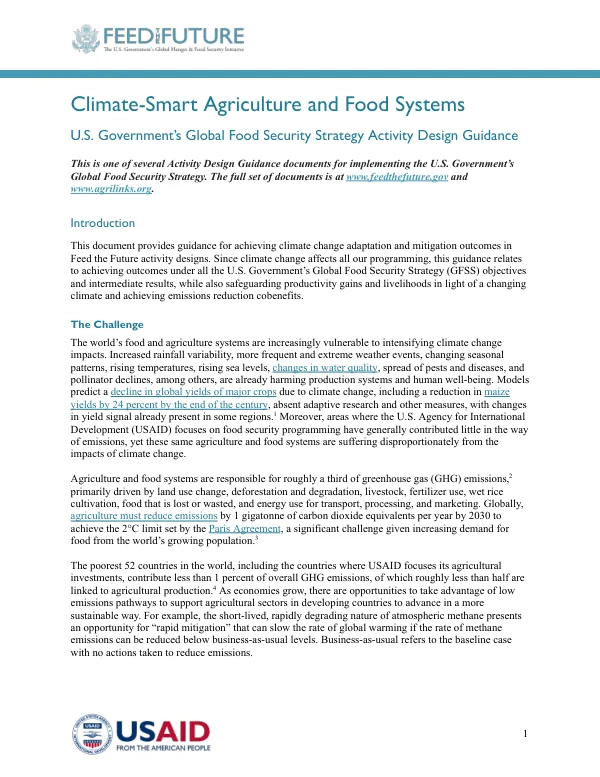
2023.1.3 Climate-Smart Agriculture and Food Systems_GFSS Activity Design Guidance
Climate-Smart Agriculture and Food Systems are integrative approaches that guide actions to transform the agriculture and food systems, aiming for three objectives: sustainably increasing agricultural productivity, adapting and building resilience to climate change, and mitigating climate change by increasing carbon sequestration or reducing greenhouse gas emissions associated with agriculture.
2023 · 11 pages
Sign in to readA free account is required to download.
Abstract
The world's food and agriculture systems are increasingly vulnerable to intensifying climate change impacts, including increased rainfall variability, more frequent and extreme weather events, changing seasonal patterns, rising temperatures, and rising sea levels. Models predict a decline in global yields of major crops due to climate change, with a reduction in maize yields by 24 percent by the end of the century, absent adaptive research and other measures. Agriculture and food systems are responsible for roughly a third of greenhouse gas emissions, primarily driven by land use change, deforestation and degradation, livestock, fertilizer use, wet rice cultivation, food that is lost or wasted, and energy use for transport, processing, and marketing. The poorest 52 countries in the world, including the countries where USAID focuses its agricultural investments, contribute less than 1 percent of overall GHG emissions, of which roughly less than half are linked to agricultural production. Climate-Smart Agriculture and Food Systems aim to transform the agriculture and food systems by sustainably increasing agricultural productivity, adapting and building resilience to climate change, and mitigating climate change by increasing carbon sequestration or reducing greenhouse gas emissions associated with agriculture. This approach broadens the lens past producers to examine these three objectives throughout the functions, capacities, and inputs of the agriculture and food systems, including the people, behavior, relationships, and resources involved in the production, storage, processing, and distribution of crops, livestock, forestry, and wild-caught fisheries and aquaculture. The USAID Climate Strategy 2022-2030 guides the Agency's approach to helping partner countries mitigate GHG emissions and build resilience to climate change, and improving USAID's operations. Activity design teams should review the Climate Strategy, its foundational principles, strategic objectives, intermediate results, and targets and consider what components are relevant for the activity and what targets are feasible for the activity to contribute to. The USAID Climate Strategy targets include mitigation, natural and managed ecosystems, adaptation, finance, country support, critical populations, and terminology and context. Adaptation refers to the process of adjusting to the actual or expected climate and its effects in order to moderate harm or exploit beneficial opportunities. The goal of climate adaptation programming is to enhance resilience and reduce the vulnerability of people, places, systems, and livelihoods to actual or expected impacts of climate change. Agriculture and Food System refers to the intact or whole unit made up of interrelated components of people, behaviors, relationships, and land, water, and other resources that interact in the production, processing, packaging, transporting, trade, marketing, consumption, and use of food, feed, fiber, and other outputs through aquaculture, farming, wild fisheries, forestry, and pastoralism. Designing activities should incorporate the priority areas identified in the GFSS and the principles highlighted in the USAID Climate Strategy, including locally led development, equity and inclusion, and private sector engagement. Activities should be tailored to the end user and be context appropriate, and should center actions in the context of the diverse communities in which USAID works, ensuring that local, marginalized, and underrepresented groups are meaningfully engaged in and lead efforts related to climate change, and receive equitable opportunities and benefits.