USAID DEC
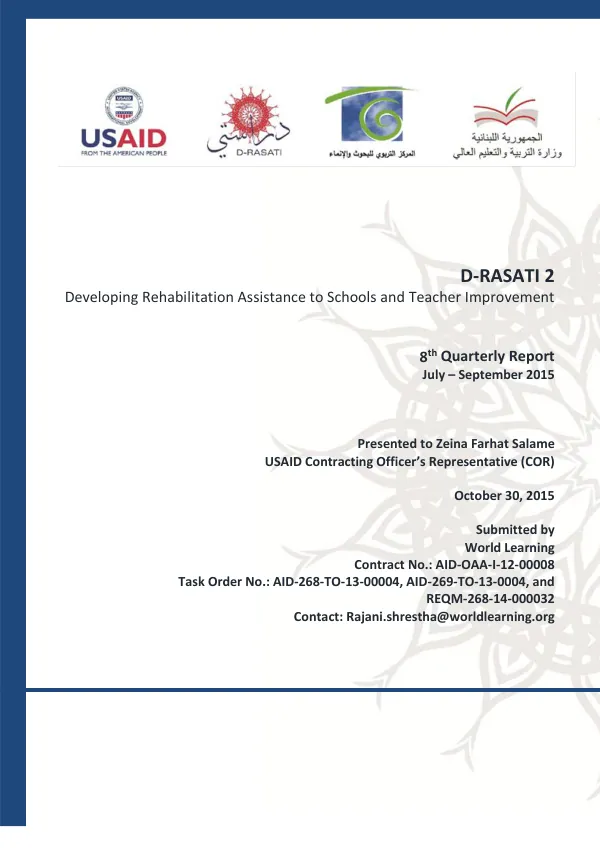
8th Quarterly Report: Developing Rehabilitation Assistance to Schools and Teacher Improvement (D-RASATI 2)
Sign inUSAID
8th Quarterly Report: Developing Rehabilitation Assistance to Schools and Teacher Improvement (D-RASATI 2)
The Developing Rehabilitation Assistance to Schools and Teacher Improvement (D-RASATI 2) program is a USAID-funded initiative aimed at improving the performance of the Lebanese public school system.
2015 · 33 pages
Sign in to readA free account is required to download.
Abstract
The program's overarching goal is to support the Ministry of Education and Higher Education (MEHE) in delivering high-quality public education, comparable to the private school system. D-RASATI 2 was launched in October 2013 with an original completion date of September 2015 and a $24.5 million budget. The program has three components: Provision of Equipment and Computer Labs to Public Schools, Provision of In-Service Public School Teacher Training, and School Leadership Development with Parents and Community Involvement. Component 1 involves providing equipment and computer labs to public schools, while Component 2 focuses on training public school teachers in English language and ICT skills. Component 3 aims to develop school leadership and increase parent and community involvement. The program's specific objectives include enhancing learning environments in public schools, providing dynamic learning opportunities to school administrators and teachers, and increasing parent and community involvement. D-RASATI 2 involves staff from MEHE and the Center for Education and Research and Development (CERD) in each of its components to embed institutional capacity and operational and technical know-how in the structure of Lebanon's public school system. On September 29, 2014, USAID approved a contract modification to increase D-RASATI 2's budget by $4.5 million, from $24.5 million to $29 million, and to extend the completion date by 6 months to March 30, 2016. The program's scope of work was also expanded to target schools most affected by the Syrian refugee crisis. The program's implementation plan includes several tasks, such as developing an ICT action plan, procuring ICT equipment, training public school teachers, and expanding extra-curricular activities. The program's monitoring and evaluation plan involves tracking progress, assessing impact, and making adjustments as needed. The D-RASATI 2 program has made significant progress in its first two years, with achievements including the development of an ICT action plan, the procurement of ICT equipment, and the training of public school teachers. The program has also expanded its scope to target schools most affected by the Syrian refugee crisis. The program's future plans include continuing to implement its activities, monitoring and evaluating its progress, and making adjustments as needed. The program's ultimate goal is to improve the performance of the Lebanese public school system and provide high-quality education to all students. The program's indicators and targets include increasing the number of public schools with ICT equipment, improving the English language skills of public school teachers, and increasing parent and community involvement in public schools. The program's results table for the reporting quarter shows significant progress in these areas, with 150 public schools equipped with ICT equipment, 500 public school teachers trained in English language and ICT skills, and 20,000 parents and community members involved in public schools. The program's recommendations for immediate action in the next quarter include continuing to implement its activities, monitoring and evaluating its progress, and making adjustments as needed. The program's ultimate goal is to improve the performance of the Lebanese public school system and provide high-quality education to all students.
Related documents