THE WORLD FOOD PROGRAMME
A-133 Compliance Supplement for Food for Peace Development Assistance Program
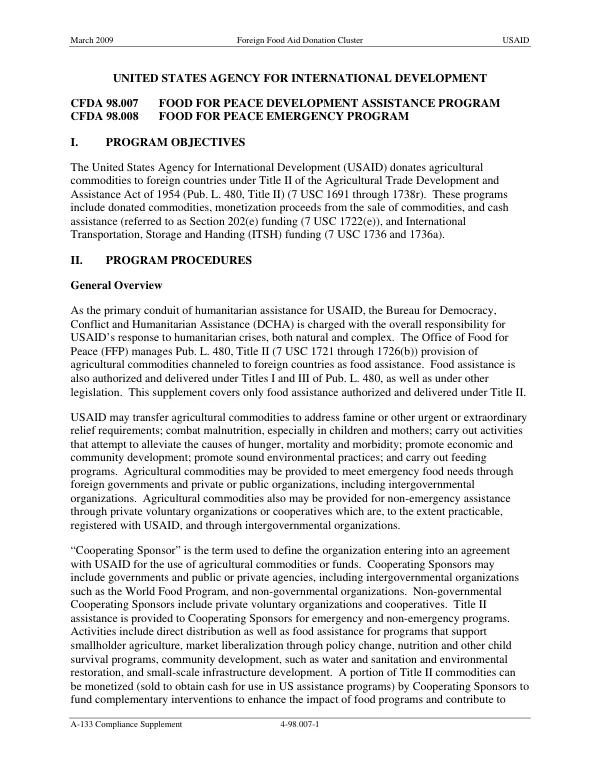
The Foreign Food Aid Donation Cluster is a program administered by the United States Agency for International Development (USAID) under Title II of the Agricultural Trade Development and Assistance Act of 1954.
2009 · 6 pages
Sign in to readA free account is required to download.
Abstract
The program provides agricultural commodities to foreign countries for emergency and non-emergency food assistance. USAID may transfer commodities to address famine or other urgent relief requirements, combat malnutrition, and promote economic and community development. Cooperating Sponsors, which include governments, public or private agencies, and non-governmental organizations, enter into agreements with USAID for the use of agricultural commodities or funds. These agreements must establish terms and conditions for conducting a Title II program in accordance with 22 CFR part 211. Cooperating Sponsors may also enter into agreements with Recipient Agencies for the delivery of program services, which must require the recipient agency to compensate the Cooperating Sponsor for any assets generated by the program. Monetization is a critical resource for Cooperating Sponsors, and they remain responsible for the commodities, monetized proceeds, and program income in accordance with the Operational Plan or Transfer Authorization. In addition to commodities and monetization proceeds, cash resources, known as 202(e) funds, are made available to Cooperating Sponsors for establishing new programs and meeting administrative, management, and personnel costs. The program is authorized under Title II of the Agricultural Trade Development and Assistance Act of 1954 and implementing regulations are found at 22 CFR part 211. USAID maintains a webpage with information on the "Food for Peace" program, including laws, regulations, and other information. The program is subject to compliance requirements, which include activities allowed or unallowed, use of funds, and use of commodities and monetization proceeds. Cooperating Sponsors are required to provide proper storage, care, and handling of commodities, and they are not required to monitor, manage, report on, or account for the commodities. However, they are responsible for ensuring that the commodities are used in accordance with the Operational Plan or Transfer Authorization. The program also requires Cooperating Sponsors to enter into agreements with Recipient Agencies for the delivery of program services, which must require the recipient agency to compensate the Cooperating Sponsor for any assets generated by the program. The program's implementing regulations are found at 22 CFR part 211, and the program is subject to compliance requirements, which include activities allowed or unallowed, use of funds, and use of commodities and monetization proceeds. Cooperating Sponsors must comply with these requirements to ensure that the program is implemented in accordance with the terms and conditions of the agreement.
Related documents