USAID DEC
A Comparative Look at Informal Science Education and Environmental Education in Bengkulu Province, Indonesia and North Carolina, USA
Sign inUSAID DEC
A Comparative Look at Informal Science Education and Environmental Education in Bengkulu Province, Indonesia and North Carolina, USA
Informal science education and environmental education in developing countries face unique challenges.
2017 · 1 pages
Sign in to readA free account is required to download.
Abstract
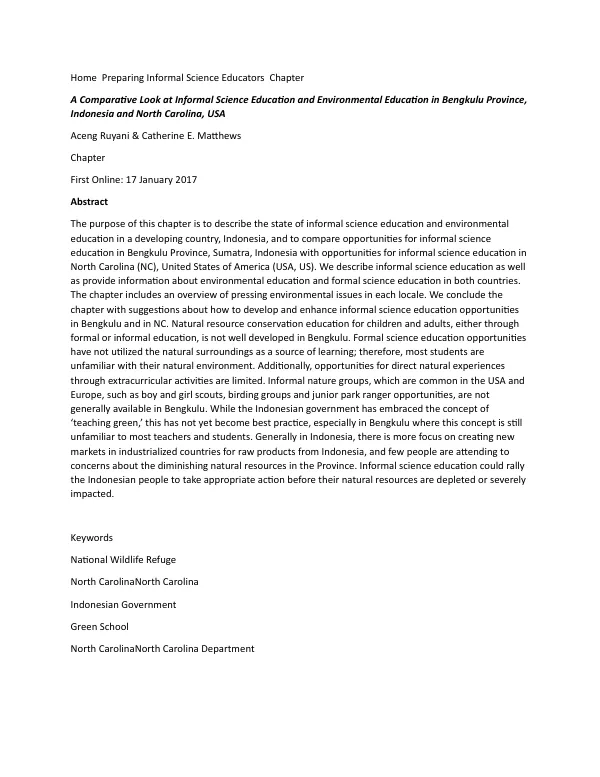
In Bengkulu Province, Sumatra, Indonesia, natural resource conservation education for children and adults is not well developed. Formal science education opportunities have not utilized the natural surroundings as a source of learning, resulting in students being unfamiliar with their natural environment. Additionally, opportunities for direct natural experiences through extracurricular activities are limited. Informal nature groups, common in the USA and Europe, are not generally available in Bengkulu. The Indonesian government has embraced the concept of 'teaching green,' but this has not yet become best practice, especially in Bengkulu where this concept is still unfamiliar to most teachers and students. In Indonesia, there is a greater focus on creating new markets in industrialized countries for raw products from Indonesia, with few people attending to concerns about diminishing natural resources in the province. Informal science education could rally the Indonesian people to take appropriate action before their natural resources are depleted or severely impacted. In contrast, North Carolina, USA, has a more developed informal science education system. The state's natural resource conservation education is supported by organizations such as the North Carolina Department of Environment and Natural Resources. The state's informal science education opportunities include programs like the North Carolina Wildlife Resources Commission's youth education programs and the North Carolina Zoological Park's educational programs. These programs provide hands-on learning experiences for children and adults, promoting environmental awareness and conservation. The comparison between Bengkulu Province and North Carolina highlights the need for informal science education in developing countries. Informal science education can play a crucial role in promoting environmental awareness and conservation, particularly in areas where formal science education opportunities are limited. By developing and enhancing informal science education opportunities in Bengkulu, the Indonesian government can help rally the people to take action to conserve their natural resources. The chapter concludes with suggestions for developing and enhancing informal science education opportunities in Bengkulu and North Carolina. These suggestions include establishing partnerships between educational institutions and conservation organizations, developing curricula that incorporate hands-on learning experiences, and promoting environmental awareness through community-based programs. By implementing these suggestions, the Indonesian government and educational institutions in North Carolina can work together to promote environmental conservation and sustainability.
Related documents