USAID DEC
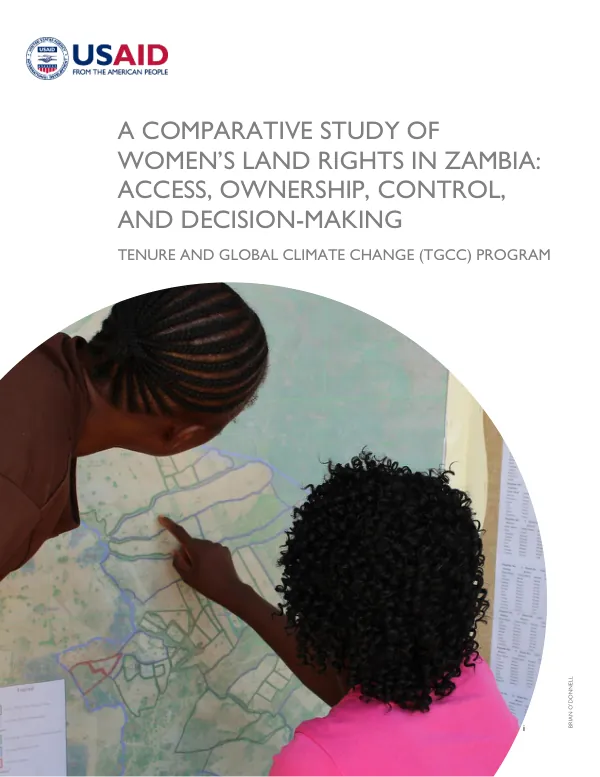
A Comparative Study of Women’s Land Rights in Zambia: Access, Ownership, Control, and Decision-Making
Sign inTETRA TECH
A Comparative Study of Women’s Land Rights in Zambia: Access, Ownership, Control, and Decision-Making
Customary land documentation in Zambia has remained elusive, with a general understanding that whatever is customary is usually not written and remains undocumented.
2017 · 25 pages
Sign in to readA free account is required to download.
Abstract
This has led to insecurity of tenure, further leading to conflicts and disputes in determining boundaries to the extent of one's land. In order to improve security of tenure, the documentation of customary rights has been promoted in Zambia, and increasingly across a range of countries. The documentation of customary rights supports an evidence base, not only for individual rights, but also for communal and concurrent rights. Village titles, certificates or rights of occupancy, group ranches, flexible titles, land sharing constructions, customary rights issued by Land Boards, co-ownership, and communal titles are examples of rights recognition tools that can be used. However, in Zambia, these models are piloted amidst a gap in legal frameworks to support the documents. Zambia operates a dual land tenure system, one of customary rights, which is governed by traditional authorities (chief/chieftainess and headmen), and statutory tenure, which is based on Government of Zambia land laws. Statutory tenure allows for individual ownership rights and other formal land rights transfer and has a documented legislative framework to support this. Customary land tenure is a flexible system that evolves over time based on the traditions and practices of a group of people. Often, customary tenure is undocumented and ownership focuses on the community or tribe. Women make up almost 50% of Zambia's approximately 17 million inhabitants, with about 60% of the country's population living in rural areas. According to the Food and Agriculture Organization of the United Nations, land tenure is the relationship, whether legally or customarily defined, among people, as individuals or groups, with respect to land. Statutory tenure allows for individual ownership rights and other formal land rights transfer and has a documented legislative framework to support this. Exact figures on the percentage of customary land in Zambia as compared to state land vary, with figures ranging from 65% to 95%. These contrasting figures are based on judgments of whether Zambia's protected area network are in customary land or state land, and whether customary land, as established at independence, converts to state land when it is placed under leasehold. Zambia's draft Land Policy stipulates that a minimum of 30% of available land in Zambia should be set aside for women and other disadvantaged groups, however several studies have shown that efforts to provide equitable access to land and strengthen land tenure for the most marginalized groups, including women, are yet to be fully realized. In Zambia, customary land is land overseen and administered by chiefs, with over 70 tribes and 288 chiefs, this control is mostly based on customs and traditions and is heavily reliant on these central figures. Through their headmen and other traditional structures, chiefs allocate land, regulate transfers of land, and control the use of it. Quite strictly, customary tenure is not defined in Zambian laws, though it is recognized and legally protected as a form of landholding. Customary law varies substantially from place to place and a lack of national guidelines on customary land administration means that each chiefdom administers customary land according to prevailing traditional norms, customs, and cultural practices. According to statutory law, women in Zambia can apply for any land in any part of the country, just like their male counterparts. In rural areas, married women usually have access to land for farming through their husbands. In the event of divorce or widowhood, if the husband dies without leaving a will and if he held state land, the Intestate Succession Act regulates that the surviving spouse inherits 20% of the deceased's estates, including land, and together with the children, the house. However, this Act is not applied generally on customary land. If the deceased husband held customary land, the widow may be permitted to continue to use the land. But the widow may also be evicted from the land by the relatives of the deceased. Growing interest to institutionalize women's right to land is born of the recognition of the importance of women's access, control, ownership, and decision-making in relation to land in Zambia. Part of this change is articulated in Zambia's 2016 draft Land Policy, which aims to "adopt a unified approach to land governance that recognizes and respects customary land rights, and promotes equitable access to land for all, including women and other disadvantaged groups."
Related documents