USAID DEC
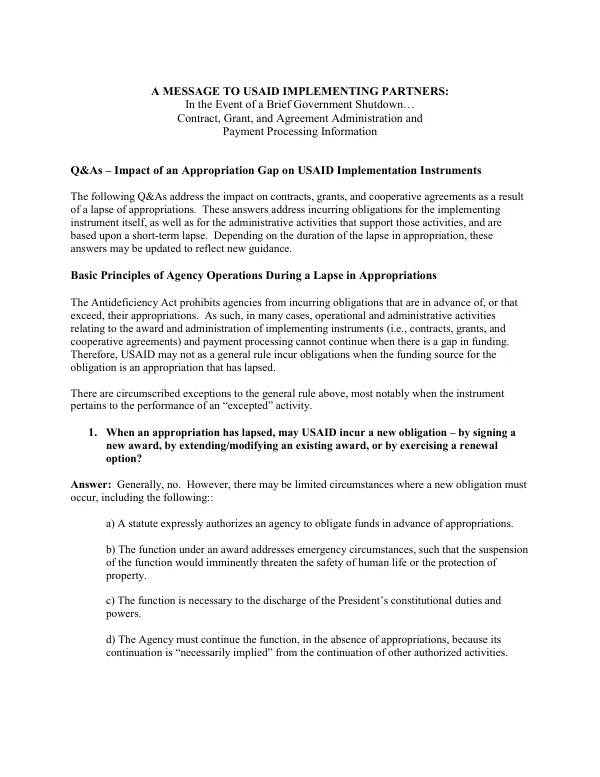
A MESSAGE TO USAID IMPLEMENTING PARTNERS: In the Event of a Brief Government Shutdown… Contract, Grant, and Agreement Administration and Payment Processing Information
Sign inUSAID
A MESSAGE TO USAID IMPLEMENTING PARTNERS: In the Event of a Brief Government Shutdown… Contract, Grant, and Agreement Administration and Payment Processing Information
A lapse in appropriations may impact the administration and payment processing of USAID implementing instruments, including contracts, grants, and cooperative agreements.
2011 · 3 pages
Sign in to readA free account is required to download.
Abstract
The Antideficiency Act prohibits agencies from incurring obligations that are in advance of or exceed their appropriations. As a result, operational and administrative activities related to the award and administration of implementing instruments and payment processing may not continue when there is a gap in funding. Exceptions to this general rule include "excepted" activities, which are typically emergency circumstances that threaten human life or property, or functions necessary to the discharge of the President's constitutional duties and powers. In these limited circumstances, USAID may incur obligations, but the agency cannot pay implementing partners until appropriations are reinstated. Implementing partners are expected to continue working during the funding gap, unless instructed otherwise by a Contracting Officer's Representative (COR) or Agreement Officer's Representative (AOR). Personal Services Contractors (PSCs) performing "excepted" functions will continue to report to work, as will program- and Office of the Economist-funded PSCs performing activities for which funds have already been obligated and are still available. Decisions relating to Foreign Service National PSCs will factor in the impact of host country labor laws. Implementing partners working under Interagency Agreements (IAAs) are expected to continue working during the funding gap, with guidance from the funding agency. A period of performance extension may be allowed when obligated funds in the award are available to cover the extended period. However, under the assumption of a brief shutdown, the need for no-cost extensions is expected to be minimal, and these situations will be addressed on a case-by-case basis. Implementing partners will be paid, but generally not until an appropriation is reinstated. If an implementing partner continues performance under its award that is currently funded from sources other than lapsed appropriations, payment delays may occur due to personnel required to process invoices and payments being affected by the funding lapse. Contractors and recipients are cautioned against continuing to work at their own risk, as such decisions would not be authorized activities for which a formal USG appropriation and obligation exists. Where activities are deemed "excepted," upon proper notification by the COR or AOR, the implementing partner or USPSC will be paid. Contractors and recipients will have access to Government resources to the extent they are not subject to the funding lapse. If access to Government resources is not readily available, personnel working under contracts that do not fall into the "excepted" category may experience difficulties accessing necessary resources due to the lack of USG personnel.
Related documents