USAID DEC
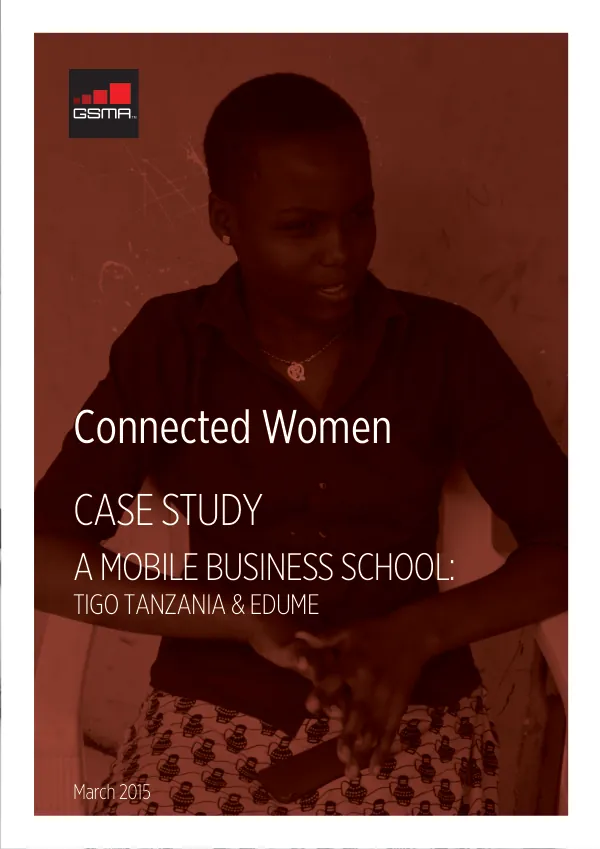
A Mobile Business School: TIGO TANZANIA & EDUME
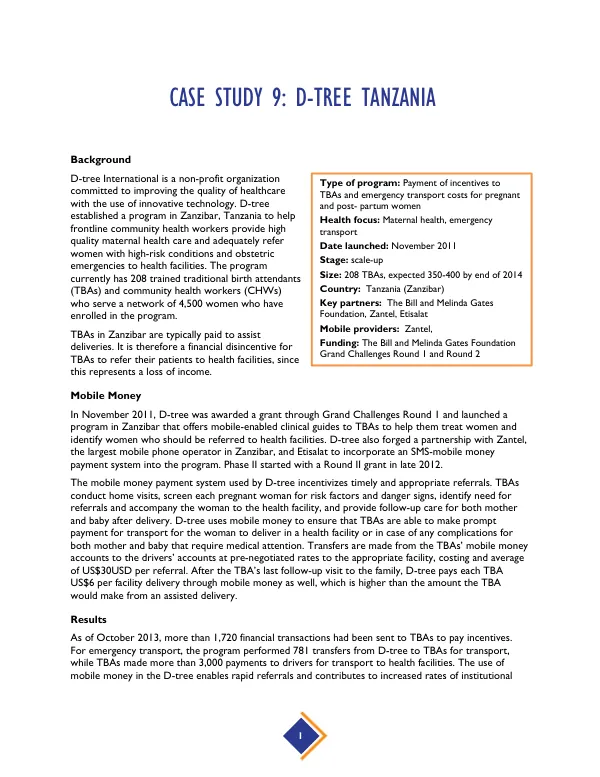
Tigo Tanzania's business training service, Tigo Biashara, was launched in October 2014 as a partnership with EduMe, a global educational service established by Tigo's parent company, Millicom.
2015 · 23 pages
Sign in to readA free account is required to download.
Abstract
The service delivers business education training via SMS and voice messaging to low-income women in Tanzania, a previously untapped segment of the market. The commercial aim of the service was to improve the perception of the Tigo brand, increase average revenue per user (ARPU) through the subscription fee, and increase usage of mobile services by Tigo Biashara users. The service was designed in response to a qualitative research study commissioned by Tigo Tanzania, which showed that women attributed a great deal of importance to business and saw it as essential to meeting other priorities, such as health and education for themselves and their families. However, these women felt a lack of business acumen and skills were preventing them from pursuing their goals. The research also highlighted the potential for mobile-based business training to improve the livelihoods of female micro-entrepreneurs across Tanzania. Early results from a January 2015 evaluation showed that Tigo Biashara users find the training content useful, relevant, and engaging. For example, 78% of female users reported improved business knowledge and 75% reported improved employment/business opportunities as a result of using the service. Female respondents rated all aspects of the service more highly than male respondents, which could indicate they value the service more because it is harder for women to access this type of information in Tanzania than men. Interestingly, 92% of female users reported greater confidence in using a mobile as a result of the service. As of early March 2015, direct revenues and user numbers are still low, but an improved version of the service product has just been re-launched. Over 11,000 users have registered for the service, and all have listened to at least one lesson. With 75% of users surveyed stating they are 'very likely' or 'likely' to continue to pay for the service, the initial feedback from users bodes well for the future of Tigo Biashara. Some interesting trends may be emerging in terms of the additional commercial benefits for Tigo Tanzania, including a more positive impression of the Tigo brand and increased use of Tigo for voice and SMS. Tanzania is one of the world's poorest economies, with a GDP per capita of $1775 and a heavily dependent economy on agriculture. The country has enjoyed relative political stability, unlike many of its neighbours. The mobile market in Tanzania is highly competitive, with four main operators: Airtel, Tigo, Vodacom, and Zantel. Teledensity stands at 68% (as of September 2014), and subscriber growth has slowed dramatically over the last decade. However, with unique subscriber penetration at just 36% in Q3 2014, there is still a large number of potential customers for operators to attract and retain. Women play a strong role in Tanzania's economy, with labour force participation rates of 90% for women and 91% for men. However, there are significant gender disparities in income, with the mean monthly income of women in the manufacturing sector being 3.5 times lower than that of men. The literacy gap between women and men is sizeable, with only 61% of female adults compared to 76% of male adults being literate. However, this gap narrows for the youth population, indicating that the difference will not be so pronounced in the next generation.